Korwin-Piotrowska Leaves the Tribunal as Proceedings Move to District Court
On November 17, the Constitutional Tribunal was scheduled to consider motions filed by Prosecutor General Waldemar Żurek seeking to lift the judicial immunity of Tribunal President Bogdan Święczkowski and Judge Bartłomiej Sochański. In Święczkowski’s case, prosecutors are also seeking authorization for his arrest and pretrial detention.
Instead of a regular hearing at the Tribunal’s headquarters, however, events took an extraordinary turn, illustrating the extent of the chaos surrounding the institution.


Continued below the video.
Early in the morning, Bogdan Święczkowski appeared outside the Constitutional Tribunal building. He demanded to be allowed inside and called for what he described as “criminal meetings” to stop. He challenged the legality of the assembly convened by Anna Korwin-Piotrowska.
Korwin-Piotrowska subsequently notified participants by text message that the hearing scheduled for noon would take place at the Warsaw District Court on Solidarności Avenue, rather than at the Tribunal.
Święczkowski announced that he would not participate in what he called a “social gathering.”
At around 11 a.m., Korwin-Piotrowska and a group of judges left the Tribunal’s headquarters and headed to the court. The group was escorted by the State Protection Service (SOP), the government agency responsible for protecting senior state officials. Police patrols and riot police vehicles were also deployed at the scene. The hearing was scheduled to take place in Room 314M, located within a designated “security zone.”
It is difficult to ignore how unusual this situation is. A constitutional body of the Polish state has moved its proceedings to an ordinary court instead of meeting at its own headquarters. Those attending are being protected by the state security service responsible for the safety of the country’s top officials.
A Judge Who Has Not Taken the Oath Is Running the Tribunal?
Today’s events are the latest episode in a conflict that escalated in late October.
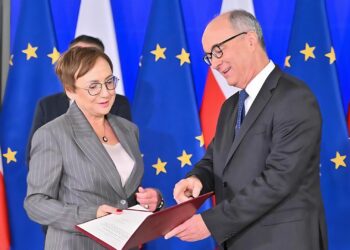
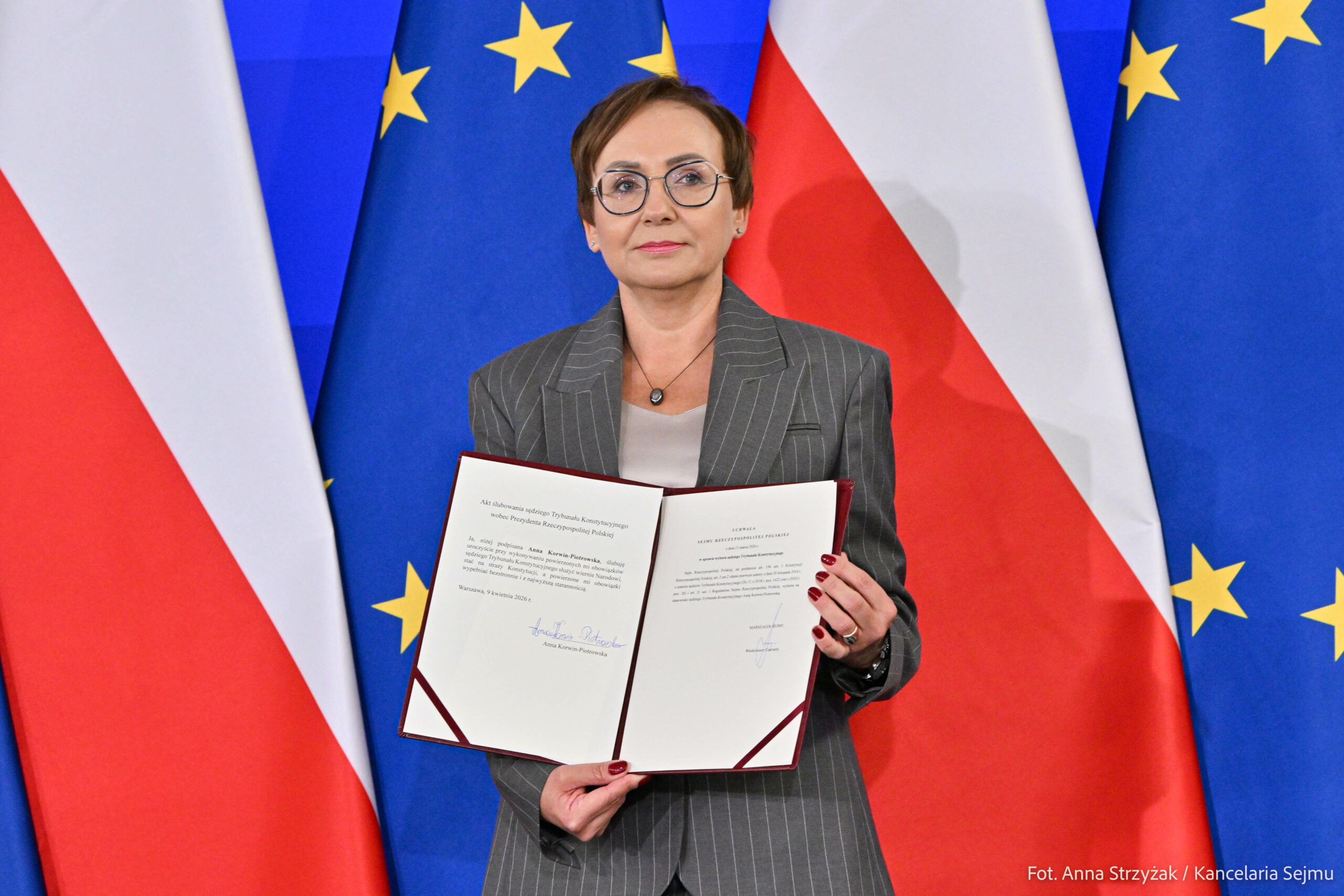
Anna Korwin-Piotrowska was elected to the Constitutional Tribunal by the current parliament in March 2026. However, President Karol Nawrocki did not administer her judicial oath, citing doubts about the legality of her election and those of several other judges.
It is worth recalling that Parliament had not filled vacancies on the Constitutional Tribunal beginning in November 2024. The legal status of Korwin-Piotrowska’s election and the consequences of her not taking the oath are among the central issues in the dispute.
On October 30, the woman who considers herself a Constitutional Tribunal judge announced that, as the judge with the longest seniority, she was taking over the leadership of the Tribunal. She subsequently issued orders imposing a “one-month suspension of duties” on Bogdan Święczkowski and Bartłomiej Sochański.
She cited provisions of the law governing the organization and proceedings of the Constitutional Tribunal. The Supreme Court recently challenged her order, ruling that it had no legal basis.
The legality of these actions is disputed by a large part of the Polish judicial community and by the president. The other side maintains that its decisions are intended to restore the Tribunal’s proper functioning.
Confrontation at the Tribunal and a Prosecutorial Investigation
The conflict reached a particularly tense point during the night of October 30–31. President Nawrocki interrupted his trip to Senegal and appeared at the Constitutional Tribunal building. A confrontation with a group of judges took place near the entrance.
The woman who has declared herself head of the Tribunal claimed that the president had “rammed into” her and the other judges, describing a physical struggle at the doorway. Nawrocki, for his part, consistently challenged the status of those elected by the current parliament and their right to claim that they were judges of the Constitutional Tribunal.
Prosecutors opened an investigation into, among other things, suspected physical assaults on judges, including Anna Korwin-Piotrowska and Krystian Markiewicz.
Rule of Law or Institutional Farce?
Today’s decision to move the proceedings to the Warsaw District Court is more than an administrative oddity. It shows just how far the conflict over the Constitutional Tribunal has gone.
One group of individuals is making decisions about who runs the institution. Another challenges their authority. The dispute over who has the right to perform official duties has spilled out of the courtroom and into hallways, outside the building, and into other state institutions.
Continued below the photo.

Particularly troubling is the fact that decisions concerning judicial immunity are at the center of this conflict. Lifting a judge’s immunity is not a routine administrative procedure. It can open the door to criminal proceedings and coercive measures. If the process itself is legally flawed, it could have a damaging effect on the independence of other judges across Poland. Perhaps that is precisely what Donald Tusk’s government wants.
A show of force, security escorts, and moving hearings from one building to another cannot replace a legal answer to the question of whether these actions are lawful. Neither the presence of the SOP nor police vehicles settles who is right in this legal dispute.
The Constitutional Tribunal does not belong to any political faction. If the institution charged with upholding the Constitution cannot determine who has the legal authority to run it, the problem goes far beyond a personal feud between judges.
And the image of a purported Constitutional Tribunal judge leaving the Tribunal’s headquarters and moving proceedings to an ordinary court under SOP protection is hardly what a normally functioning justice system looks like.