

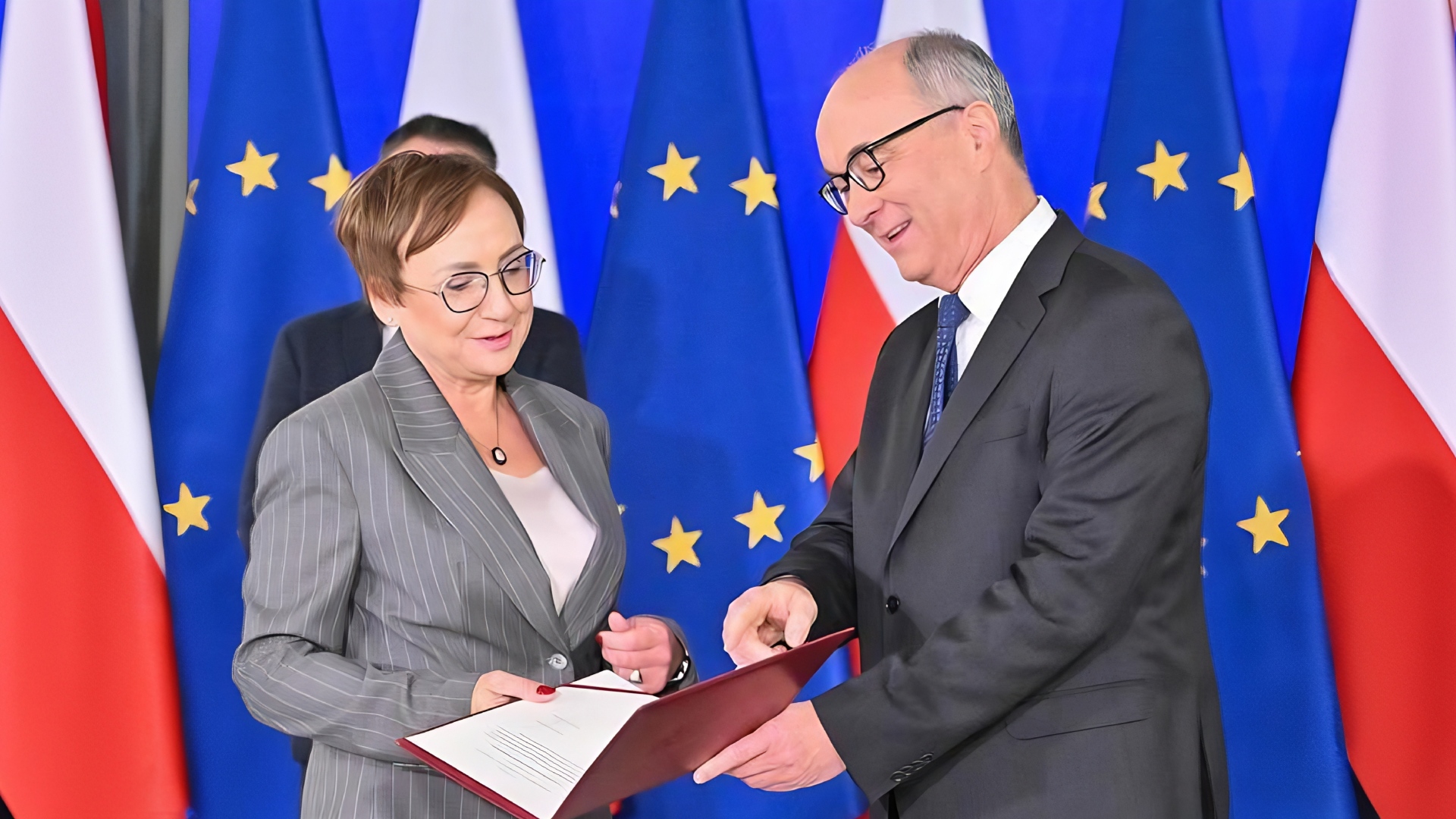
Senator Gabriela Morawska-Stanecka, a former deputy speaker of Poland’s Senate, has suggested that publishing a photograph of Anna Korwin-Piotrowska alongside Sejm Speaker Włodzimierz Czarzasty could lead to legal consequences. She claims the image is being used to spread disinformation and imply political collusion. But the real dispute concerns something far more serious: the legality of actions taken at Poland’s Constitutional Tribunal.
Morawska-Stanecka Responds to an Online Post
The controversy began with a post on X commenting on developments at Poland’s Constitutional Tribunal and a disputed interpretation of the rules governing the quorum of the Tribunal’s General Assembly of Judges.

The post read:
“This is what makes this political caste so ‘extraordinary.’ Even mathematics works in their favor! Once they have managed to bring the queen of sciences under their control, no legal question should frighten them anymore.”
Gabriela Morawska-Stanecka, a former deputy speaker of the Senate, responded by accusing the authors of disinformation and warning of possible legal consequences.
“The height of disinformation is publishing a photograph from the swearing-in ceremony of Constitutional Tribunal judges and using it to suggest some kind of political deal. I won’t even mention that such insinuations could carry legal consequences. It’s easy to write nonsense under a pseudonym, isn’t it?”
— she wrote.
@Prosty_z_prawej Szczytem dezinformacji jest pokazywanie zdjęcia z zaprzysiężenia sędziów TK i sugerowanie jakichś układów. Nie dodaję nawet, że takie insynuacje mogą rodzić odpowiedzialność prawną. Fajnie jest wypisywać brednie pod pseudonimem, prawda?
— Gabriela Morawska-Stanecka (@GabrielaMorStan) November 3, 2026
There is, however, a fundamental issue with her argument. The constitutional oath taken by judges before the President and other forms of administering an oath are two different matters. They cannot simply be treated as interchangeable, particularly when the dispute concerns the constitutional powers of the head of state.
The Math Behind the Constitutional Tribunal Dispute
The original post referred to a dispute over the quorum required for the General Assembly of Constitutional Tribunal judges.
Under the applicable rules, the assembly can adopt resolutions only if at least two-thirds of the Tribunal’s total number of judges are present. Since the statutory number of judges is 15, that means at least 10 must attend.
Critics of Anna Korwin-Piotrowska’s actions argue that she is attempting to change the way the required majority is calculated by excluding some judges from the count. If the calculation is instead based on 12 judges, two-thirds comes to eight.
But that interpretation requires a legal justification. Arithmetic alone cannot establish a different legal basis for calculating the quorum.
The criticism is not coming only from the political opponents of Donald Tusk’s government. Professor Marcin Matczak, a constitutional law scholar who was frequently critical of the previous actions of Law and Justice (PiS) party, has also sharply condemned the current government’s approach to the Tribunal. In a post on X, he warned that lowering the quorum requirement by suspending the Tribunal’s president and vice president could open a Pandora’s box:
“Lowering the quorum threshold as a result of suspending the president and vice president opens a Pandora’s box. This is a mechanism that allows the quorum of the Constitutional Tribunal’s General Assembly to be lowered at will. All it takes is for the president to suspend 10 judges, and three people could then make decisions at the General Assembly. This makes no sense.”
Obniżenie progu kworum na skutek zawieszenia prezesa i wiceprezesa otwiera puszkę Pandory. To jest mechanizm, który pozwala dowolnie obniżać kworum na Zgromadzeniu Ogólnym TK – wystarczy, że prezes zawiesi 10 sędziów i będzie mógł na Zgromadzeniu podejmować decyzję w trzy osoby. To jest bez sensu.
— Marcin Matczak (@wsamraz) November 3, 2026
Matczak’s criticism is particularly difficult to dismiss as partisan opposition. A legal scholar who repeatedly challenged the previous government’s actions is now warning that the current administration’s approach creates a mechanism for manipulating the Tribunal’s decision-making rules.
Another scholar, professor Maciej Gutowski, commenting on the dispute on Radio Poznań, put it simply:
“Mathematics is unforgiving.”
Apparently, not everyone respects the basic rules of mathematics. The question is whether they will respect the law. There are serious reasons to doubt it.
Can Criticism of the Government Become a Legal Liability?
Morawska-Stanecka’s response raises further questions. The former deputy Senate speaker did not identify a specific legal provision that might have been violated by publishing a publicly known photograph accompanied by political commentary. That omission is particularly striking given her legal background. She is a trained lawyer who spent years working as an attorney and notary. Instead of identifying a potential offense, she issued a general warning about possible legal consequences.
Expressing a negative opinion about politicians or officials of state institutions is not a crime. At least, it should not be. Yet we have serious concerns that courts and tribunals taken over by force by the current government may increasingly become instruments for arbitrary interpretations of facts and intentions. That is not something we can afford to ignore.
“Prosty z prawej” is an independent, self-funded Polish media project established by journalists dismissed from Poland’s public media during so called liquidation process launched in December 2023. Its authors are widely known in Polish media circles, and their identities are publicly available.
There is one more point worth making. If politicians and representatives of the governing camp want to convince the public that their position in the Constitutional Tribunal dispute is legally sound, they should address the legal arguments.
Threatening people with legal consequences for critical commentary does nothing to resolve whether the actions taken at the Tribunal are lawful. It does, however, raise legitimate concerns about how much criticism of those in power they are prepared to tolerate.
Polish independent authors state, they are prepared to take responsibility for what they say. The question is whether the politicians dismantling Poland are equally prepared to take responsibility for what they are doing.



