

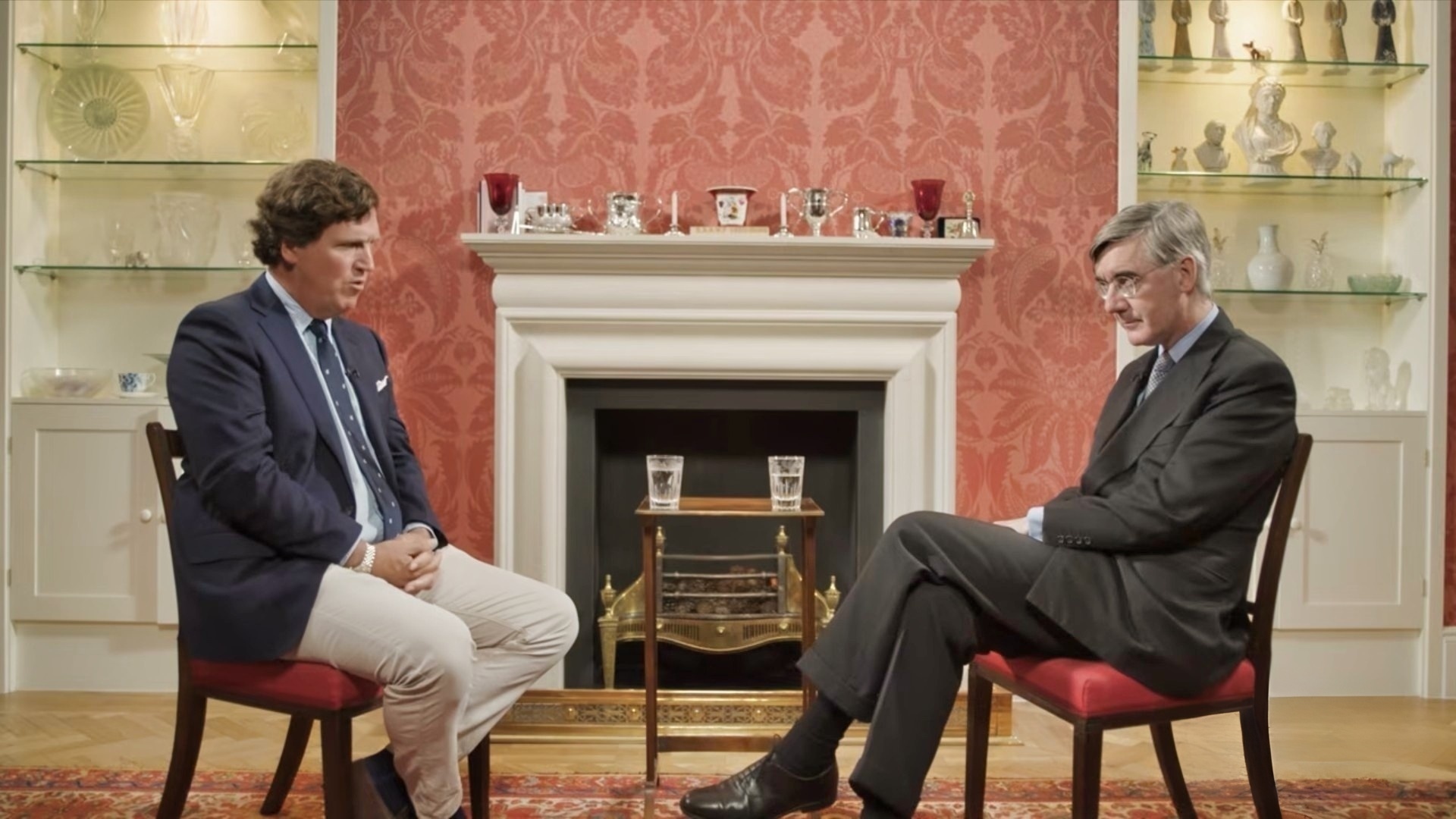
In his online program, Tucker Carlson spoke with Sir Jacob Rees-Mogg, a British Conservative politician, former government minister, and longtime member of Parliament. Their conversation touched on deterrence, Britain’s security, and the war in Ukraine.
At one point, Carlson began questioning the rationale behind Britain’s involvement in World War II. In doing so, he referred to Germany’s territorial claims against Poland.


“…Hitler said that 15% of Poland used to be Germany and was given to Poland under the Treaty of Versailles; it was German territory with Germans. That was his position and, by the way, it was true, except that the Polish borders were carved out.
Listen, I’m not here to defend Hitler. I’m just saying that the idea that Hitler just randomly invaded Poland is a lie and everybody believes it because they know nothing about the facts. The truth is that large pieces of territory were taken away from Germany, including parts of Prussia, and given to another country. This drove the Germans crazy. Maybe it shouldn’t have, but it did. And that was the justification for it. Britain had absolutely nothing to do with it.”
The word “justification” is the key here. Carlson had already qualified his remarks by saying, “I’m not here to defend Hitler.” Moments later, however, he presented an argument that effectively reduces German aggression to a dispute over borders.
Continue reading below the reel.
Carlson uses a classic rhetorical maneuver: after declaring neutrality, he introduces a qualification and then explicitly legitimizes Nazi aggression by calling the territorial claims of the Third Reich a “justification” for the invasion. The result of this attempt at nuance is deeply misleading – the commentator reduces a genocidal invasion to an “understandable border dispute” and echoes the propaganda narrative of Goebbels and Hitler.
This was not an isolated incident. Later in the conversation, Carlson argued that Britain had no reason to become involved in the conflict with the Third Reich. When Rees-Mogg pointed out that without defeating Hitler, the British might be speaking German today, Carlson gave a brief response: “Who cares?”
Rees-Mogg: Hitler Attacked Because the West Was Weak
Rees-Mogg did not accept his interlocutor’s argument. In his view, the lack of adequate deterrence was precisely what encouraged Hitler to commit aggression.
“If Hitler had thought we were strong, Poland would not have been invaded.”
– the British politician said.
Rees-Mogg also accused Carlson of placing too much faith in Hitler’s arguments.
“You seem to put more faith in Hitler than I do.”
– he said. He added that he was surprised Carlson was “coming close to defending Hitler.”
In his view, the war against the Third Reich was a confrontation between good and evil and a struggle against the greatest threat the world knew at the time.
Polish Embassy: “A Colossal Insult”
The Polish Embassy in Washington responded to Carlson’s remarks. Bogdan Klich, serving as chargé d’affaires a.i., sent the commentator a letter of protest.
Klich described his remarks as an “colossal insult” to the millions of victims of Nazism and Allied soldiers. He accused Carlson of becoming an apologist for Hitler under the banner of free speech and of repeating historical falsehoods.
Letter from CdA a.i. @BogdanKlich calling on @TuckerCarlson to publicly retract his outrageous statements and apologize for insulting Poles, British citizens, and, ultimately, the memory of the victims of the Shoah and all those who died in the fight against Nazism. https://t.co/OdCXHgZfNw
— Embassy of Poland U.S. (@PolishEmbassyUS) October 5, 2026
The Polish diplomat pointed out that:
the purpose of the German invasion was not to resolve a border dispute, but to destroy the Polish state and exterminate its population.
He called on Carlson to publicly apologize and retract his remarks.
There is another problem, however. Poland has not had a full-fledged ambassador in Washington for several years. The mission is headed by a chargé d’affaires. At a time when Poland needs to firmly defend its position before American public opinion, it is difficult to regard such an arrangement as an asset for Polish diplomacy.
Tucker Carlson – An Argument Taken from Putin
Most troubling is the similarity between Carlson’s reasoning and the arguments used by Vladimir Putin.
In February 2024, Putin, in an interview with Carlson himself, delivered a lengthy pseudo-historical account of Ukraine. He questioned its right to exist as an independent state and presented his own version of history as a justification for Russian aggression.
The mechanism is similar:
- pointing to an alleged historical grievance,
- questioning a neighbor’s right to its current borders,
- and finally presenting aggression as a response to a previous injustice.
In Poland’s case, the problem is even more serious. German aggression in 1939 quickly demonstrated that this was not about correcting a border. What followed the conquest was terror, the destruction of the Polish state, mass executions, and the systematic extermination of the population.
History Is Not a Justification for Genocidal Aggression
Carlson also ignores the broader context of German policy toward Central Europe. The concept of Mitteleuropa, developed in German political thought before World War II, envisaged subordinating the region to Berlin’s interests.
In German political thought, Poland was never meant to be an equal partner of Germany, regardless of where the borders were drawn.
Between 1939 and 1945, this policy took the form of brutal conquest. That is why presenting the invasion of Poland as the consequence of a “German sense of grievance” is more than a historical oversimplification. It reverses cause and effect.
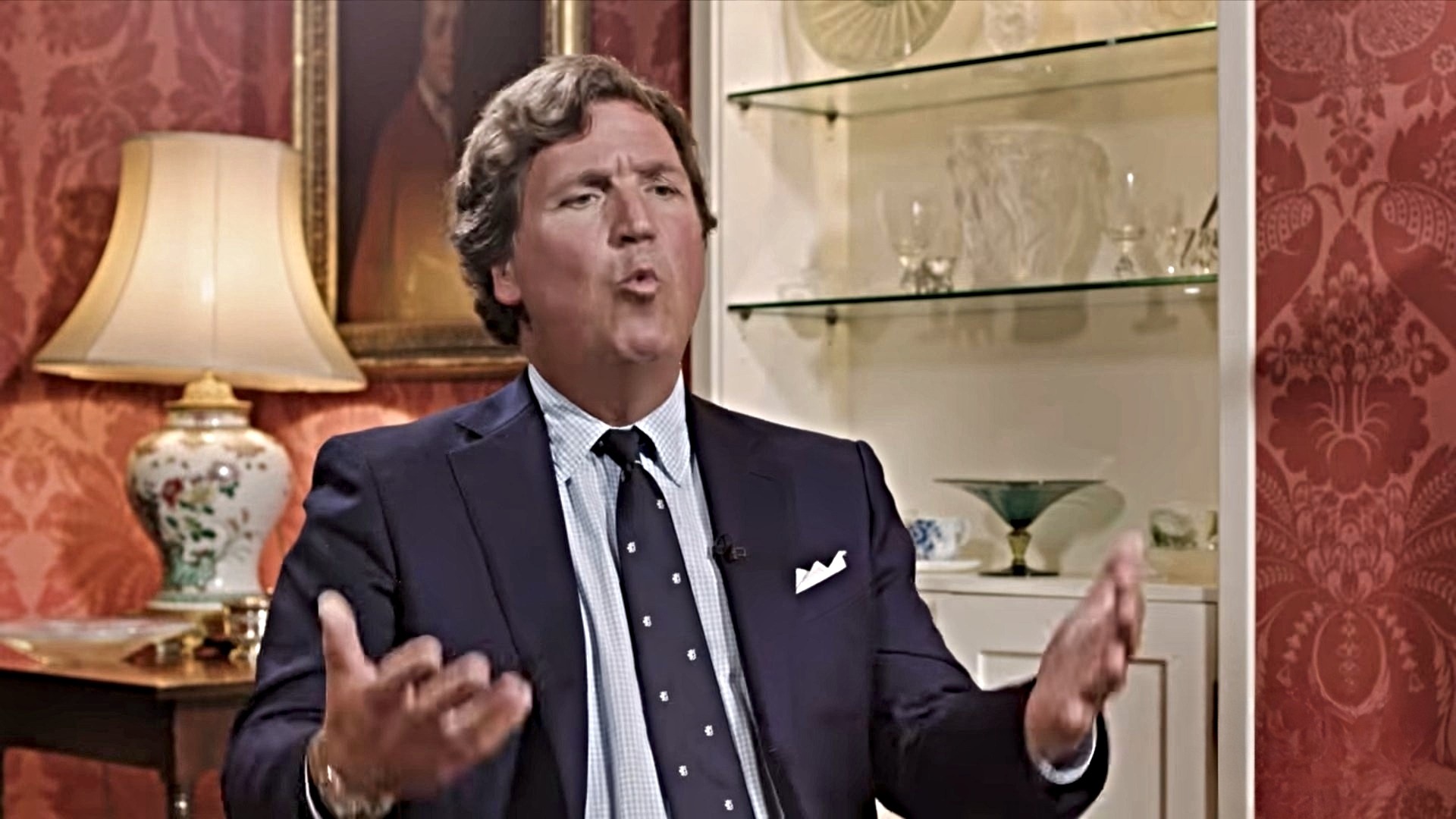
Carlson is, of course, entitled to his own views, even if they are wrong. Americans’ knowledge of Poland, however, remains quite limited. Studies show that more than 60 percent of young Americans primarily associate Poland with World War II, while more than 62 percent cannot name a single well-known Pole. Under such circumstances, oversimplifications and false interpretations of history, especially when spread by popular commentators, can easily reach audiences that lack the knowledge needed to verify them.
There is no reason to pretend that a historical falsehood becomes true simply because it is spoken by an influential American commentator.
The problem is bigger than one scandalous interview. If aggression can be justified by “historical grievances,” the same logic can be used to justify future wars. European history shows where that logic can lead.
Paradoxically, Tucker Carlson has turned out to be war’s greatest advocate.



