While Elon Musk sends rockets towards Mars and scientists work in the sweat of their brows on nuclear fusion to provide us with free and clean energy, the European Union is fighting its most important battle of the 21st century with admirable self-denial.
It’s a fight that the cap from your favorite kefir will never, under any circumstances, experience loneliness and remain faithful to its bottle forever. As Łukasz Warzecha rightly points out, these nuts have become “a symbol of the sclerosis that is rolling the European Union” and proof of how officials are able to heroically solve problems that no one has seen before and which no one needed to solve.
The effects of this heroic battle are stunning, although – as in the war – the costs are considerable. According to the PwC report, the entire “cap-attached” operation could cost the beverage sector in the EU from 2.7 billion to even 8.7 billion euros. In Poland alone, the costs were real and painful – only one plant, Mlekpol, had to spend PLN 30 million on the modernization of the trifle line.
What’s more, in the name of saving the planet from littering the beaches, although as Warzecha ironically says that it is not known how it is supposed to help the beaches in India – from 50 to 200 thousand tons of additional plastic were generated annually throughout the Union, from which all these armored hinges were made. You could say: more plastic to fight plastic. Logic worthy of the highest laurels of Brussels cabinets.
Now, however, we are receiving news that the European Commission – as part of the “Better Regulation” procedure – ordered a formal evaluation of the regulations. It is not a sudden evacuation from the once chosen clear path, but a systematic examination of whether what was supposed to make us happy did not become our torment. Brussels, instead of admitting its mistake, now invites us to share opinions as part of the so-called “call for evidence”.
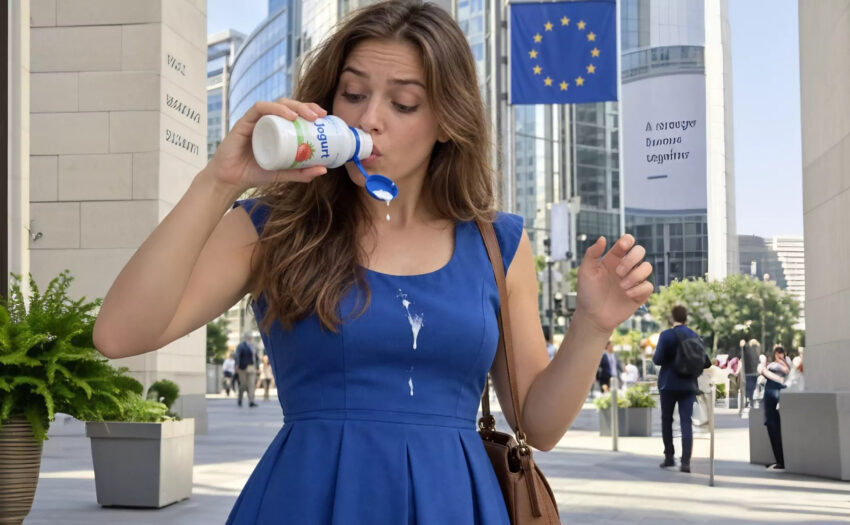
This is the moment when every consumer can officially describe “in three copies with a photo” of how an EU invention hits him in the nose while drinking or funds a free yoghurt shower.
Unfortunately, even European science still remains helpless against gravity. Although engineers promise caps that tilt at an angle of 180 degrees to improve comfort, the problem of mousses and drinks dripping on the user, which from the trapped lid in a joyful stream directly on our original clothes, has not yet been solved. This is a challenge that may wait for another directive and another billion euros from PwC reports.
In this context, it is difficult not to agree with Warzecha that we are dealing with a “departure” and interference of officials in the market sphere, which results in absurd, unwanted solutions.
Instead of dealing with competitiveness, Europe has become a global leader in the design of bottle hinges.
To sum up, we have more plastic, we have spent billions, and now we will “evaluate” until 2027 whether 180 degrees is already freedom or still cap oppression. However, we are safe – as long as the cap holds the bottle, the future of European civilization seems unthreatened and the money for tens of thousands of EC officials must simply be found. For the future of the planet.
Naturally!