
In the face of real hybrid threats from Russia, deliberately fueling public panic through a nonexistent written “secret CIA report” has become a dangerous game. Instead of strengthening Poland’s security, it – whether consciously or not – serves the Kremlin’s psychological objectives. Whatever one may think of Donald Trump, he is the only one who has thrown a lifeline to the emotions of Poles in recent days.
A sense of security among citizens is an absolute foundation of state stability, particularly at a time of growing hybrid threats from the Russian Federation on NATO’s eastern flank. However, artificially fueling an atmosphere of fear and invoking nonexistent documents when the threat itself is very real is an exceptionally destructive course of action. When the head of government resorts to dramatic rhetoric and invokes a “secret report” that never actually existed on his desk, the line between responsible warning of citizens and cynically playing into Russia’s psychological warfare strategy becomes blurred.
Tusk and the Timeline of Manipulating Poles’ Fear
The sequence of events in September 2026 reveals a mechanism for building media tension around alleged intelligence findings.
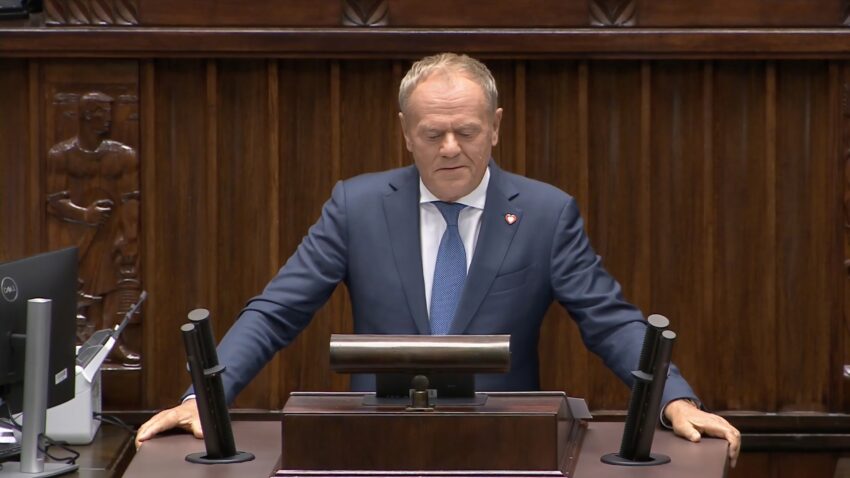
September 8, 2026 – Tomasz Siemoniak, the minister coordinating Poland’s special services, met with CIA Director John Ratcliffe in Washington and subsequently gave the prime minister an oral briefing on the talks, including discussions of Russian sabotage. September 10, 2026 – during a press conference following the Visegrád Group summit in Bratislava, Donald Tusk publicly stated: “In the past few hours, I received a fairly precise report directly from the CIA director concerning possible events in the coming months,” warning of worst-case scenarios on NATO’s eastern flank. September 17, 2026 – on the symbolic anniversary of the Soviet invasion, the prime minister unexpectedly appeared at the Sejm podium, presenting a vision of “critical months” ahead and hybrid missile and drone strikes against countries supporting Ukraine.
It is worth noting that in his speech, Donald Tusk emphasized the Russian Federation’s new technological capabilities – jet-powered drones that are currently difficult to effectively counter – as well as not only attacks on Ukraine but also the inevitability of attacks on Poland and other countries on NATO’s eastern flank.
Donald Tusk also stated that the goal of Russian disinformation is to promote the idea that peace should be negotiated and military operations in Ukraine should be brought to an end. According to Tusk, peace would benefit Russia alone.
What Was the “Secret CIA Report” Really?
It quickly became clear that no formal written “secret CIA report” in the form of an intelligence document handed over to the Polish prime minister had ever existed.
Tomasz Siemoniak himself acknowledged in media interviews that it was merely an oral account of his visit to the United States, which he conveyed to Donald Tusk, and that the prime minister had used the word “report” rather loosely. The American side, meanwhile, traditionally avoids publicly commenting on or denying statements of this kind by politicians, which is standard intelligence practice in matters covered by secrecy classifications.
Inconsistency in the Response: Words Instead of Raising the CRP Alert Levels
If the Polish authorities had actually received a shocking, hard intelligence report from the CIA about a direct threat to the country, the state should have responded by immediately raising its protective measures. It did not.
The rest of the article continues below the post.
Under Poland’s June 10, 2016, Anti-Terrorism Act, the prime minister has a four-level alert system (ALFA, BRAVO, CHARLIE, DELTA), along with corresponding levels for cyberspace (CRP). At the time, however, Poland remained at the routine second-level BRAVO and BRAVO-CRP. If the threat had been as unprecedented as Tusk claimed, the state’s responsibilities would have called for the introduction of CHARLIE or DELTA levels and the immediate placement of the services on full alert. Instead of operational decisions, however, the public received political messaging and promises of mobile shelters, which may suggest that the issue was being used for domestic political purposes. There is no point in hiding it – it was a very ugly game, one that fits the Kremlin’s objectives.
Fear as a Tool of Kremlin Sabotage – What the Experts Say
Comparing the government’s actions with the assessments of security analysts leads to troubling conclusions. Experts from NATO and think tanks such as RUSI and the Institute for Central Europe agree:
“The primary goal of Russian sabotage and hybrid operations is to spread panic, generate uncertainty, and paralyze societies’ will to resist.”
As NATO’s official position states:
“Russia wants to create fear, destabilize our societies, and discourage us from supporting Ukraine.”
Analyses by DEFENSEMAGAZINE point in the same direction, stating that Russia’s objective is to “sow fear and panic, overwhelm security forces… and exert social pressure on governments.” Expert Jakub Godzimirski emphasizes that hybrid operations are aimed at “political destabilization… creating chaos, social polarization, and weakening trust in public institutions”.
Why, then, does the head of the Polish government, instead of calming emotions and strengthening intelligence protection after the alleged CIA information, himself become a conduit for fear? By stoking fear, politicians – whether unintentionally or deliberately – help Russia achieve its primary psychological objective.
Tusk Returns to Old Patterns
Scaring people with Russia and “flexibly managing emotions,” as practiced by Donald Tusk, is not a new phenomenon. From 2007 to 2014, his political camp favored dialogue with the Kremlin (“with Russia as it is”). In January 2011, during parliamentary debates surrounding the Smolensk disaster, Tusk argued:
“For Poland, it is better to know the truth and have no war than not to know the truth and have war.”
Following the annexation of Crimea in 2014, he sought on the one hand to reassure the public that a direct conflict did not threaten Poland, while on the other, his warnings were described in headlines across numerous media outlets as “scaremongering about war.” His current shift toward extreme alarmist messaging fits the same pattern of using geopolitics for domestic political purposes.
Treason Against the State in Legal and Political Terms
The term “treason against the state” does not appear under that name in Polish criminal law – its legal equivalent is Article 127 of the Criminal Code (coup d’état), which protects the independence and constitutional order of the Republic of Poland. In public discourse, however, the term refers to the most serious betrayal of the state’s interests.
Deliberately misleading Poles on a massive scale, creating a false atmosphere of mass hysteria, and undermining public morale at a time of real danger – which has existed since February 24, 2022 – amounts to a betrayal of Poland’s national interest.
Tusk’s Manipulations in the Shadow of the September 17
The possibility of a deliberate attempt to mislead Poles immediately before September 17 adds another dimension to the matter.
History has shown that Moscow (from the Soviet Union to today’s Russia) has systematically used historical anniversaries to escalate tensions and stage provocations: from the Mainila provocation in 1939 to the disgraceful statement issued by the Russian Embassy in Warsaw on September 17, 2026, distorting the history of the Molotov-Ribbentrop Pact.
Heightening the sense of danger with a nonexistent document precisely during this window of time makes it easier for the Kremlin to impose its own narrative and destabilize Polish public opinion.
Who Benefits?
When we connect all the dots – Russia’s fear-based hybrid warfare doctrine, the absence of an actual CIA document, the lack of any real decisions to raise the alert levels of the services (such as CRP), and the political context of Tusk’s actions – the conclusion seems obvious.
Building political capital on citizens’ fears and operating through falsehoods does not serve Poland’s security. Only one actor benefits from the emotional paralysis of Poles and the resulting information chaos – the Russian Federation.
The only significant political and emotional counterweight in the public sphere to the rhetoric of fear and the inevitability of an attack has been Donald Trump’s statement:
“GREAT NEWS! Thanks to the bold leadership of my friend, Karol Nawrocki, President of Poland, major progress is being made toward establishing a U.S. Army base in Poland. If this happens, the location of the base will be announced very soon. This will be a historic step for our great U.S./Polish Alliance. Thank you for your attention to this matter. President DONALD J. TRUMP”
– Trump wrote on Truth Social.
If Russian hybrid warfare is about inducing fear, Trump’s widely discussed post is perhaps the clearest counterpoint, showing that Poland lies within the orbit of U.S. interests and, fortunately, is not entirely dependent on “secret CIA reports” that apparently only Donald Tusk ever saw.