Tuesday, October 20, 2026
The 🇵🇱 Poland Report
  • Home
  • News
  • Backgrounders
  • About Us
  • Contact
No Result
View All Result
  • Home
  • News
  • Backgrounders
  • About Us
  • Contact
No Result
View All Result
The 🇵🇱 Poland Report
No Result
View All Result

Between Russia and Germany: The Strategic Logic That Shaped Poland’s Fate

by The Poland Report
4 March 2026
Share on Facebook
Share on Twitter

For centuries, relations between Germany and Russia have oscillated between rivalry and surprising cooperation. In many historical interpretations, the existence—or absence—of an independent Poland played a decisive role in shaping this uneasy partnership.

A Strategic Triangle in Europe

The history of relations between Germany and Russia has often been described as a cycle of estrangement and rapprochement. One of the most influential observations on this relationship was formulated by historian John Wheeler-Bennett, who noted that after 1740 the dynamics between the two powers frequently depended on the political status of Poland.


Read also

Ukraine Is Not Yet in the EU, but It Is Already Setting Tough Conditions for... Its Membership

Ukraine Is Not Yet in the EU, but It Is Already Setting Tough Conditions for… Its Membership

2 weeks ago
“I'm not here to defend Hitler”, but… Tucker Carlson Turns Out to Be War’s Greatest Advocate!

“I’m not here to defend Hitler”, but… Tucker Carlson Turns Out to Be The Greatest Advocate of Wars!

2 weeks ago

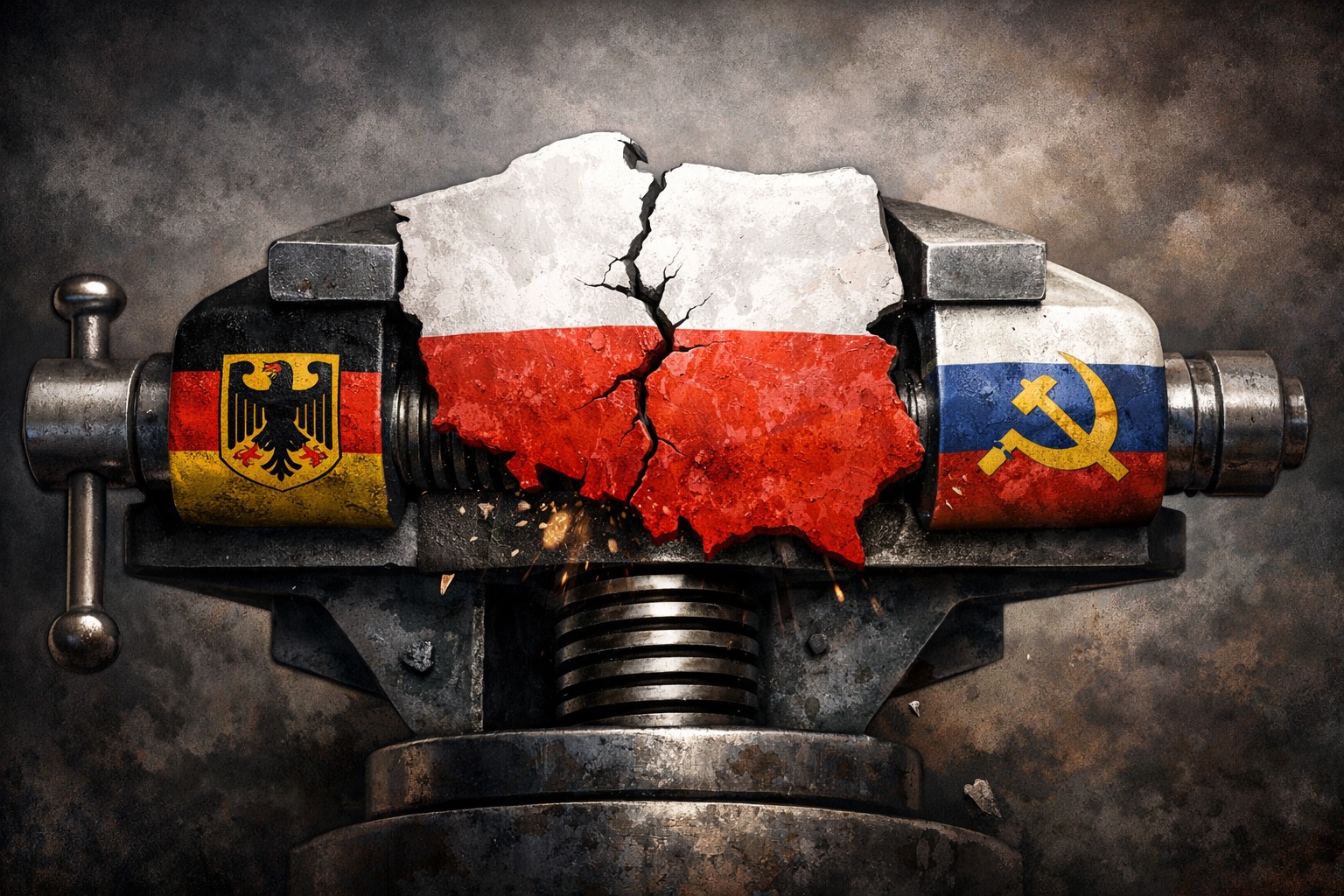
According to Wheeler-Bennett, when Germany and Russia were separated by an independent Polish state acting as a buffer, relations between the two empires tended to remain relatively stable. When their borders met directly, tensions increased and hostility often followed.

This observation reflects a broader strategic logic that shaped European geopolitics for centuries. The territory between Berlin and Moscow was rarely perceived merely as a collection of states. Instead, it often functioned as a geopolitical buffer zone whose stability—or weakness—had implications for the security calculations of both powers.

Within this framework, Poland was frequently treated not as a political subject but as a strategic space influencing the balance between Germany and Russia.

Prussian Pragmatism and the Russian Connection

In the eighteenth century, Prussian rulers openly articulated a pragmatic approach to alliances. Frederick II of Prussia, known as Frederick the Great, emphasized that alliances should serve the interests of the state rather than moral considerations.

Around the end of the Seven Years’ War in 1762, Frederick reportedly advised that rulers should never hesitate to form alliances—but should also be ready to abandon them whenever it becomes advantageous. This approach reflected the broader tradition of raison d’état, where survival and strategic advantage outweighed sentiment or ideological affinity.

Relations with Russia became one of the tools through which Prussia pursued this pragmatic policy. Cooperation with the Russian Empire often served as a means of strengthening Prussia’s position within Europe and balancing other powers.

Periods of tension between Berlin and Moscow certainly occurred, but they were frequently followed by renewed attempts at cooperation whenever strategic interests aligned.

Bismarck and the Logic of Realpolitik

In the nineteenth century, after the unification of Germany under Prussian leadership, Chancellor Otto von Bismarck elevated cooperation with Russia to a central element of German foreign policy.

Bismarck famously summarized the essence of his diplomatic strategy in a short remark: the secret of politics, he suggested, was to maintain a good treaty with Russia.

This thinking culminated in the Reinsurance Treaty of 1887, a secret agreement between Germany and Russia. The treaty guaranteed mutual neutrality in the event of certain conflicts—particularly if France attacked Germany or Austria-Hungary attacked Russia. It also tacitly acknowledged Russian ambitions in the Balkans.

Bismarck’s worldview was rooted in the belief that Germany’s strategic interests were primarily located within Europe rather than overseas colonial expansion. In an often-quoted conversation in 1888, he explained this idea metaphorically by pointing to a map of Europe and remarking that his “map of Africa” lay there—between Russia and France, with Germany positioned in the middle.

For Bismarck, managing relations with these two powers was the central task of German diplomacy.

The “Polish Question” in German Strategy

Within Prussian and later German strategic thinking, Poland was frequently perceived through the lens of geopolitical calculation.

An independent Polish state could serve as a buffer separating Germany and Russia, but it could also complicate cooperation between the two powers. At various times Poland was therefore viewed as a stabilizing barrier, a potential threat, or an object of expansion.

Anti-Polish sentiment was widespread among segments of the Prussian elite in the eighteenth and nineteenth centuries. Historical sources contain numerous hostile remarks about Poles from political figures of the era, reflecting both cultural prejudice and political rivalry.

During the nineteenth century, especially in territories such as Greater Poland and Silesia that were incorporated into Prussia, the Polish population was often seen by authorities as a possible source of internal instability. Policies of germanization, settlement programs, expulsions, and restrictions on the Polish language in schools were introduced as part of efforts to strengthen state control.

In the logic of Realpolitik, suppressing Polish national aspirations was considered necessary to maintain the cohesion and security of the Prussian-led German state.

At the same time, the “Polish question” remained a recurring concern in European diplomacy. The possibility that Polish nationalism might align with rival powers such as France or Russia was sometimes viewed as a potential trigger for wider geopolitical tensions.

History and Its Long Shadows

The complex historical relationship between Germany, Russia, and Poland did not end in the nineteenth century. In the twentieth century it took far more dramatic and tragic forms, culminating in the devastation of World War II and immense human losses across Central and Eastern Europe.

Yet the strategic patterns identified by historians continue to attract attention. The geographical reality of Central Europe—the space between Germany and Russia—remains a central factor in discussions about European security and political stability.

For centuries, Poland’s position within this triangle has shaped not only its own history but also the broader balance of power on the continent.

Whether these historical dynamics belong entirely to the past—or still echo in contemporary politics—remains a question that continues to provoke debate among historians and analysts alike.

Related Posts

Poland. Those in power are now bothered by independent online creators. They want to close the system
News

Poland. Those in power are now bothered by independent online creators. They want to close the system

Calling the independent Kanał Zero a “political party” by Bartłomiej Sienkiewicz reveals the government’s helplessness and the deep crisis of...

by The Poland Report
3 weeks ago
News

Autocratic Methods in Defense of Polish Democracy? Broadcasting Council Sounds the Alarm Over Freedom of Speech

A government bill on restrictive measures is intended to create an armor protecting Poland from hybrid attacks from the East,...

by The Poland Report
3 weeks ago
Load More
Next Post
Polish President Warns of “Debt for Generations” as He Vetoes EU SAFE Defense Loan

Polish President Warns of “Debt for Generations” as He Vetoes EU SAFE Defense Loan

Search the site

No Result
View All Result

Recent Posts

  • Ukraine Is Not Yet in the EU, but It Is Already Setting Tough Conditions for… Its Membership
  • “I’m not here to defend Hitler”, but… Tucker Carlson Turns Out to Be The Greatest Advocate of Wars!
  • Poland. Those in power are now bothered by independent online creators. They want to close the system
  • Autocratic Methods in Defense of Polish Democracy? Broadcasting Council Sounds the Alarm Over Freedom of Speech
  • Tragedy at the Abbey in Jarosław: Ukrainian Knife Attacker Fatally Wounded a Priest and Injured 4 Others
  • Donald Trump Throws a Lifeline to Poles’ Emotions Frayed by Donald Tusk
  • Nawrocki vs. Onet Trial: Where Did the Witnesses Go, and What Happened to Journalistic Integrity?
  • Poland Risks a New Yalta for Ukraine’s Sake: Could Warsaw’s Rhetoric Leave Poland Out of the Next Peace Settlement?
  • In the Shadow of Communist and Eastern Connections: Włodzimierz Czarzasty’s Case Threaten Polish Democracy
  • Zondacrypto: How Lawyers and Crypto Experts with MBA Degrees Pulled the Wool Over the Eyes of the Entire State
  • Great European battle for tethered caps! News from the front of the fight for an even greater deviation
  • The Päivi Räsänen Case – How Eurocrats Are Designing a New Gulag [COMMENTARY]
  • A Blind Spot in Warsaw: How Poland’s Post-Communist Left Compromises National Security
  • Ukraine Now Officially Holds Poland and Polish Historical Sensitivities in Contempt [COMMENTARY]
  • Russia’s Frozen Assets Protected by the Finance Minister. Poland Will Not Soon Recover PLN 174.5 Million from Gazprom

Browse topics:

ADAM BODNAR AEROSPACE AGRICULTURE attack COMMUNISM COUP DEFENCE DEMOCRACY DONALD TRUMP DONALD TUSK ECONOMY ELECTION EUROPE FOREIGN AFFAIRS FOREIGN INTERFERENCE FREEDOM FREEDOM OF SPEECH GERMAN INTERFERENCE GERMANY HATE SPEECH HISTORY JUSTICE IN POLAND KAROL NAWROCKI LABOR MARKET LAW IN POLAND NATO POLAND POLISH-GERMAN RELATIONS POLISH SOCIETY POLITICS PRESIDENT OF POLAND PROSECUTION Päivi Räsänen RUSSIA SECRET SERVICES security THREATS UKRAINE USA USAID Volhynia Massacre Volodymyr Zelenskyy WAR WŁODZIMIERZ CZARZASTY „TRANSFORMATION”
Facebook Twitter


„The Poland Report” delivers key news about Poland—unbiased, uncompromising, and impartial. We separate facts from opinions to help you understand events in a country with over 1,000 years of history and inhabited with nearly 40 million remarkable people.
Privacy Policy

Menu

  • Home
  • News
  • Backgrounders
  • About Us
  • Contact

Recent publications

  • Ukraine Is Not Yet in the EU, but It Is Already Setting Tough Conditions for… Its Membership
  • “I’m not here to defend Hitler”, but… Tucker Carlson Turns Out to Be The Greatest Advocate of Wars!
  • Poland. Those in power are now bothered by independent online creators. They want to close the system
  • Autocratic Methods in Defense of Polish Democracy? Broadcasting Council Sounds the Alarm Over Freedom of Speech
  • Tragedy at the Abbey in Jarosław: Ukrainian Knife Attacker Fatally Wounded a Priest and Injured 4 Others

The Poland Report

Manage Consent
To provide the best experiences, we use technologies like cookies to store and/or access device information. Consenting to these technologies will allow us to process data such as browsing behavior or unique IDs on this site. Not consenting or withdrawing consent, may adversely affect certain features and functions.
Functional Always active
The technical storage or access is strictly necessary for the legitimate purpose of enabling the use of a specific service explicitly requested by the subscriber or user, or for the sole purpose of carrying out the transmission of a communication over an electronic communications network.
Preferences
The technical storage or access is necessary for the legitimate purpose of storing preferences that are not requested by the subscriber or user.
Statistics
The technical storage or access that is used exclusively for statistical purposes. The technical storage or access that is used exclusively for anonymous statistical purposes. Without a subpoena, voluntary compliance on the part of your Internet Service Provider, or additional records from a third party, information stored or retrieved for this purpose alone cannot usually be used to identify you.
Marketing
The technical storage or access is required to create user profiles to send advertising, or to track the user on a website or across several websites for similar marketing purposes.
  • Manage options
  • Manage services
  • Manage {vendor_count} vendors
  • Read more about these purposes
View preferences
  • {title}
  • {title}
  • {title}
No Result
View All Result
  • Home
  • News
  • Backgrounders
  • About Us
  • Contact

© 2026 JNews - Premium WordPress news & magazine theme by Jegtheme.