
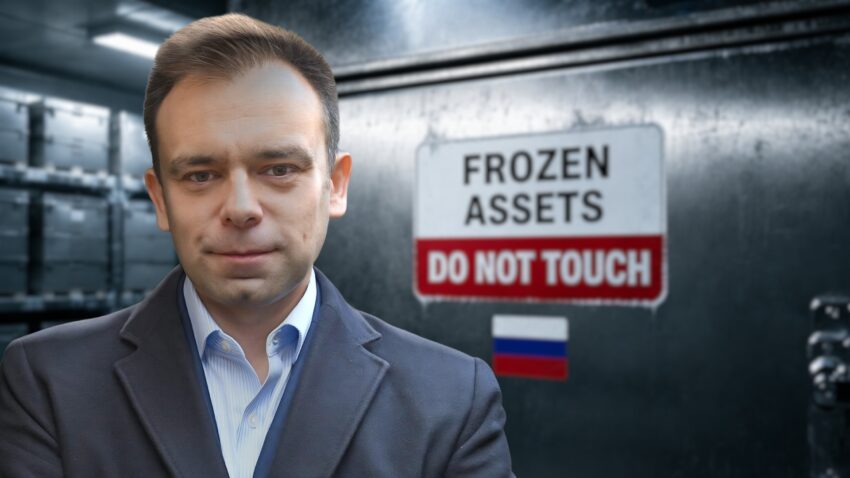
Are Polish government agencies now representing the interests of the State Treasury, or are they making sure that Gazprom’s frozen assets remain untouched? Finance Minister Andrzej Domański’s decision to block the enforcement of a court-awarded PLN 174.5 million penalty raises questions that the government will have to answer.
Frozen assets that Gazprom will not have to pay from. Minister Domański blocked enforcement
After several years of legal proceedings, Poland has still failed to recover PLN 174.5 million owed by Russia’s Gazprom. The money stems from a final court judgment upholding a fine imposed by the Office of Competition and Consumer Protection (UOKiK) for Gazprom’s refusal to cooperate during an antitrust investigation into the construction of the Nord Stream 2 pipeline.
The original penalty amounted to approximately €50 million. In 2024, the court reduced it to around €40 million, equivalent to PLN 174.5 million. The judgment became final in 2025, yet Gazprom has not paid a single zloty.
The obvious next step appeared to be enforcement against Gazprom’s frozen assets located in Poland, primarily its shares in EuRoPol Gaz.
Dispute between government agencies resolved by the minister
The Warsaw-Śródmieście Tax Office concluded that enforcement against frozen assets was legally possible. However, the Lower Silesian Customs and Tax Office in Wrocław, which is responsible for implementing sanctions against Russian entities, took the opposite position.
According to that interpretation, satisfying the State Treasury’s claim from frozen Russian assets could constitute a partial “unfreezing” of Gazprom’s property and therefore violate the sanctions regime.
The dispute was referred to Finance Minister Andrzej Domański. The minister dismissed the appeal and upheld the position of the Wrocław office, effectively blocking any possibility of collecting the money.
Between Russia and Germany: The Strategic Logic That Shaped Poland’s Fate
Head of UOKiK warns of a dangerous precedent
Last year, Poland’s Ministry of Finance had allowed the enforcement of claims against frozen Russian assets. The latest decision has drawn open criticism from UOKiK President Tomasz Chróstny. He argued that the state is giving up a genuine opportunity to recover funds lawfully awarded by the courts—money that should ultimately benefit the national budget.

Even more controversial is the fact that, according to media reports, the Ministry of Finance itself presented a legal interpretation as recently as last year that permitted such enforcement. The current reversal raises questions about the consistency of Poland’s policy toward frozen Russian assets.
The case has also taken on a political dimension. Member of Parliament Janusz Kowalski has announced a parliamentary inspection at the Ministry of Finance.
It is not only about PLN 174.5 million
PLN 174.5 million is a significant amount, but what is truly at stake appears to be much greater. A legal precedent has now been established that could make it more difficult to recover other claims against entities subject to sanctions.
The paradox is that Poland continues to bear the costs of administering frozen Russian assets while simultaneously maintaining that it cannot use those assets to satisfy its own legally established claims.
For the average taxpayer, this is difficult to understand. The state controls the debtor’s property, possesses a final court judgment, and yet declares that it cannot enforce payment.
Gazprom and Poland’s cancellation of more than one billion zlotys in debt in 2010
In 2010, Donald Tusk’s government agreed to forgive Gazprom’s liabilities related to the transit of Russian natural gas through Poland. EuRoPol Gaz, the co-owner of the Polish section of the Yamal pipeline, waived claims against Gazprom for the years 2006-2009 amounting to $286 million (approximately PLN 820-860 million at the time, worth more than PLN 1 billion today including interest). The debt cancellation formed part of a trilateral agreement under which Poland secured somewhat larger gas deliveries and a revised pricing formula, while Russia obtained debt forgiveness and lower future transit tariffs.
The decision was made under significant political pressure. Members of EuRoPol Gaz’s management board, Michał Kwiatkowski and Jerzy Tabaka, wrote to Deputy Prime Minister Waldemar Pawlak in December 2009, arguing that writing off the debt would be “grossly disadvantageous” and lacked any legal basis. In January 2010, both executives were suspended. They were quickly replaced by new board members, including representatives associated with Gazprom, among them Aleksandr Medvedev.
A later audit conducted by Poland’s Supreme Audit Office (NIK), covering the years 2011-2013 and declassified several years afterward, concluded unequivocally that EuRoPol Gaz had been politically pressured into relinquishing money that was legally owed to it, while the Polish side received no equivalent benefits in return. The auditors found that the negotiations had been conducted without proper authorization and at the expense of both the company’s interests and those of the State Treasury.
Despite the severity of the NIK findings, none of the officials responsible on the Polish side—whether from the government, PGNiG, or EuRoPol Gaz—faced any consequences. Sixteen years later, the matter remains unresolved.
It remains one of the clearest examples of what “subordinate relations” with Moscow looked like in practice during that period.
Commentary
Russian assets as a deposit safeguarded by Poland at the expense of Polish taxpayers? It is difficult to ignore the paradox of the situation. Russian assets remain frozen in Poland, yet their owner can apparently rest assured that the Polish state will protect those assets with exceptional diligence. Meanwhile, the Polish budget is unable to recover money that has been lawfully awarded by a final court judgment.
One can, of course, understand the argument that the integrity of the sanctions regime must be preserved. Sanctions should neither be circumvented nor weakened. What is much harder to accept, however, is a situation in which a mechanism intended to harm Russian interests ends up protecting the assets of a Russian state-owned company from the enforcement of debts owed to… the Polish state itself.
If this interpretation becomes permanent, frozen assets will cease to function as a tool of pressure and instead become deposits safeguarded by Poland at the expense of Polish taxpayers. That is precisely why this case extends far beyond PLN 174.5 million. It raises the fundamental question of whether the current legal framework truly serves the interests of the Republic of Poland—or whether, in practice, it guarantees the security of assets belonging to entities that are subject to sanctions.
- Puls Biznesu – Poland Will Not Recover the PLN 174.5 Million Fine from Gazprom. The Finance Minister Refused to Approve It
- Money.pl – Enforcement of the PLN 174.5 Million Fine Against Gazprom Blocked. It Was the Finance Minister’s Decision
- Business Insider Polska – Finance Ministry Blocks Enforcement of Gazprom Fine. PLN 174.5 Million Remains Out of Reach
- Interia Biznes – Poland Will Not Receive Millions from Gazprom? “The Finance Minister Blocked It”
- Bankier.pl – Absurd Dispute Between Tax Authorities. Millions in Gazprom Fines Are at Stake
- Kresy.pl – Finance Minister’s Decision Blocked Enforcement of the PLN 174.5 Million Fine Against Gazprom
- Puls Biznesu (Background Article – April 2026) – Government Office Blocks Recovery of PLN 174.5 Million from Gazprom