


Polish Foreign Minister Radosław Sikorski’s remarks about NATO defeating Russia “in a matter of weeks” triggered a sharp reaction from Moscow and sparked a debate in Poland and the West over the limits of deterrence rhetoric and Warsaw’s actual role in the peace process. For now, Warsaw increasingly appears to be acting as an envoy for war, while being consistently marginalized in peace initiatives.
What Did Radosław Sikorski Say, When, and Why?
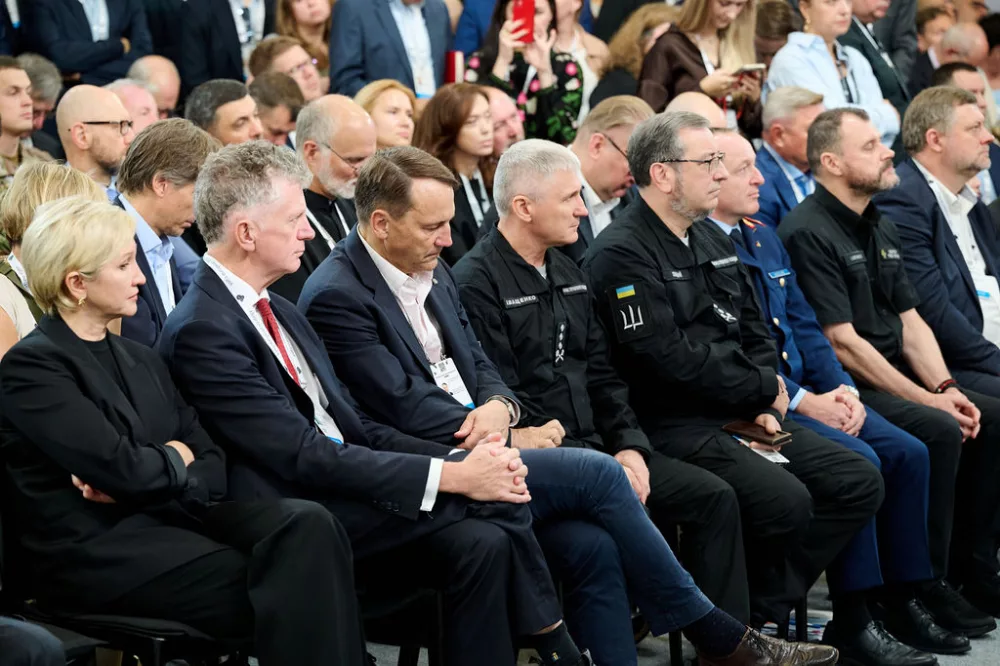
On September 11–12, 2026, during the Yalta European Strategy (YES) conference in Kyiv, Polish Deputy Prime Minister and Foreign Minister Radosław Sikorski stated that, in the event of a hypothetical Russian attack on NATO, if the Alliance were to “take the gloves off,” the aggressor could be defeated very quickly.
Sikorski pointed to the overwhelming air superiority of NATO’s European members — approximately 2,500 aircraft, even without U.S. participation — and argued that since the Ukrainians had destroyed half of Russia’s refining capacity in six months, NATO could eliminate the other half within six weeks.
He also proposed conducting intensive, aggressive military exercises in the vicinity of Kaliningrad in order to create uncertainty and force Putin to withdraw some of his ground forces from Ukraine.

Sikorski later clarified on X that his remarks referred to the potential of the European pillar of NATO’s air forces in the event of Russian aggression.
To be clear about what I said in Kyiv: that in the event of Russian aggression against NATO, thanks to its air superiority, the air forces of the European part of NATO would be able, even without U.S. participation, to destroy half of Russia’s refineries faster than Ukraine has. I still believe that.
— Radosław Sikorski 🇵🇱🇪🇺 (@sikorskiradek) September 14, 2026
The statement was part of a confrontational rhetoric aimed at deterrence, demonstrating strength, and rejecting Russian dominance, rather than a call for an offensive.
“Diplomat” Sikorski Urges Ukraine to Strike Russian Refineries and Criticizes U.S. Involvement
During the conference in Kyiv, the head of Polish diplomacy made other remarks that did not spread across the internet quite as quickly. They are worth noting here, however, because they say a great deal about the current state of Polish diplomacy and our country’s precarious position.
According to a report on the Yalta European Strategy (YES) conference website, the Polish foreign minister also discussed the reasons why Russia attacked Ukraine. He described the invasion as an expression of Putin’s hegemonic and imperial ambitions to “rule the world.” During the meeting, Radosław Sikorski also advised Ukraine:
“Negotiation is one way this war ends, but another way is that it just peters out by Putin running out of resources to continue, and for that Ukraine needs to be singularly focused on striking the refineries. If over half of Russian refineries were semi permanently damaged, he could physically not continue the war on Ukraine.”
As noted in the conference report, Sikorski also assured the audience of European energy solidarity with Ukraine and argued that Europe, including Poland, has sufficient resources:
“We need to show solidarity with Ukraine on gas and electricity. But Europe will be fine. We are much more diversified. Scandinavia has renewables. France has nuclear. In Poland, we have storage, which is already 80% full, and even if there was a complete cut off, our households-that’s about a third of consumption-we extract that domestically. So he can affect some of our fertiliser-making capacity, but he can’t shut us down.”
— Radosław Sikorski said in Kyiv.
During another day of the YES conference, Radosław Sikorski criticized the involvement of the United States, NATO’s most powerful member, in the war in Ukraine. Asked by an audience member about U.S. funding, European support, and frozen Russian assets, he said:
“The obvious answer, is that half the funding has petered out because the United States did not follow up with another supplemental package. The U.S. is not funding the war. It is selling some weapons to Europe, but it is not funding Ukraine. What would be really helpful is for the U.S. to match the European effort. The European Union has extended a €90 billion loan, which is not fully disbursed yet, and there is an obvious pot of money in frozen Russian assets. We have already said Russia is not getting this money until it has paid reparations to Ukraine. The only question is: do we pass the money to Ukraine after the war to rebuild it, or now to prevent it from being destroyed?”
All of these statements came as Russian hybrid attacks along Poland’s border were intensifying, including an attack involving Geran-5 jet drones on a Kyiv–Warsaw train and incidents just one kilometer from Polish territory.
Prime Minister Donald Tusk and Defense Minister Władysław Kosiniak-Kamysz announced a serious but non-provocative response aimed at strengthening security, while EU foreign policy chief Kaja Kallas described Russia’s actions as an attempt to intimidate the West.
Russia’s Reaction
The Polish diplomat’s remarks immediately drew a sharp response from Moscow. Maria Zakharova, spokeswoman for the Russian Foreign Ministry, commented on the minister’s words on Telegram with the brief phrase “Russophobia of the mind.”
Russian Foreign Minister Sergey Lavrov said that a hypothetical Russian attack on a Western country would be “idiocy demonstrating a complete inability to govern a state,” while warning that if a Western country attacked Russia, the confrontation would be “completely different from what is happening in Ukraine” and “very short.”
Comments in Poland and the West
In Poland, the issue triggered strong political polarization. Mainstream media reported the remarks as a firm signal consistent with the government’s policy of deterrence. The opposition and parts of the public, however, criticized the minister, accusing him of “warmongering,” being “out of touch with reality,” and gambling with the country’s security.
The recording was also frequently misrepresented online as if Sikorski had been talking about Poland’s military capabilities alone rather than those of NATO as a whole, generating hostile reactions.
Media outlets in Ukraine and on NATO’s eastern flank, including Kyiv Post and European Pravda, reported the remarks in a positive or neutral manner, emphasizing the proposal for military exercises around Kaliningrad as support for Kyiv. Western media, including Defence News and The Times, presented the issue in a more measured way, focusing on the facts and the context of the escalating hybrid attacks.
Deterrence, Military Power and Poland’s Marginalization
Radosław Sikorski’s remarks raise a fundamental question about the effectiveness and wisdom of the rhetorical strategy adopted by Poland.
Poland, located directly next to the conflict zone and itself targeted by hybrid provocations, is adopting an unusually outspoken and confrontational position. But this raises the question of whether a frontline state should be the loudest voice of deterrence when Poland itself would face the most direct risk in the event of escalation.
There is also a clear disconnect between Poland’s harsh verbal messaging and its actual diplomatic position. Although the West continues to strengthen its military capabilities and is not currently seeking a unilateral reset with Moscow, the main channels for discussions about a possible ceasefire or a future peace settlement are taking place outside Warsaw.
Examples include U.S. contacts involving Trump’s envoys Steve Witkoff and Jared Kushner in Moscow and Kyiv, as well as discussions within the E3 framework of Germany, France, and the United Kingdom. Poland’s role in diplomatic or peace processes is currently almost negligible.
When the day eventually comes for the West or Ukraine to sit down with the Russian Federation at the negotiating table — and we should hope that some table will still exist — Poland may find itself unacceptable to either side because of its rhetoric.
And then Yalta could happen all over again. The danger is not that Poland would literally be handed over to a foreign power in a repeat of the 1945 conference. The deeper concern is that, once again, decisions affecting Poland’s security and future could be made elsewhere, by others, while Poland has little or no influence over the outcome.
It would be better for Poland’s Foreign Ministry to make sure that history does not repeat itself than to publicly advise Ukraine on military strategy.