


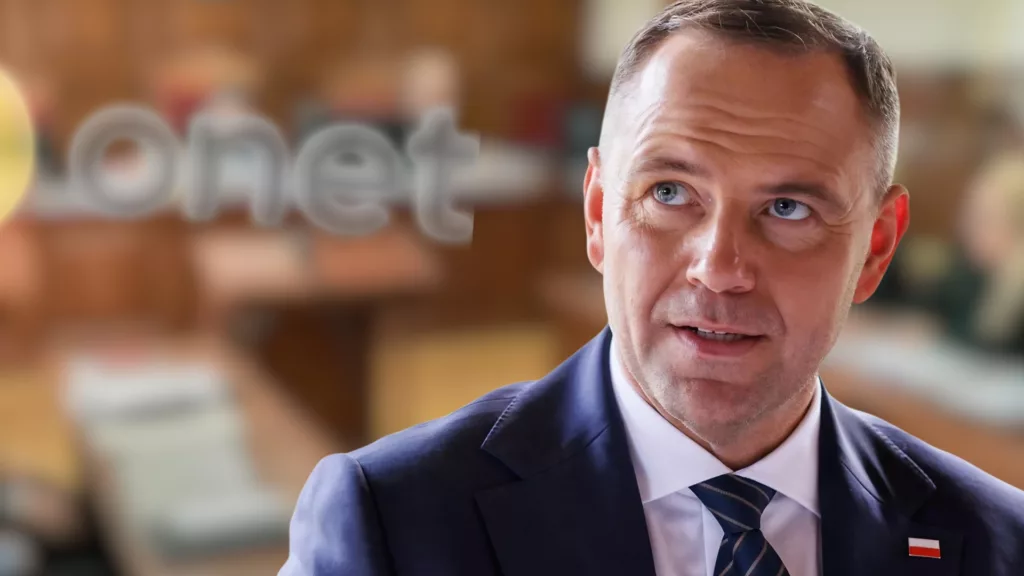
A civil lawsuit over the protection of personal rights, brought by Karol Nawrocki against the publisher of the Onet news portal, has begun before the Warsaw Regional Court. Yet events that unfolded during the very first days of the trial have already been astonishing.
At the court hearing, key witnesses called by the defense – Onet journalists Magdalena Rigamonti, Kamil Dziubka, and Magdalena Gałczyńska – were expected to appear. However, as reported by DoRzeczy, instead of testifying and defending the claims made in the media, none of them showed up in court, and their absence was not excused in any way. What is more, attorneys for Ringier Axel Springer Polska (RASP) unexpectedly withdrew their requests to have the journalists questioned as witnesses.
Instead of the newsroom’s journalists, according to a report by niezalezna.pl, a witness with a rather unusual reputation was set to appear – Olgierd L., known by the nickname “Olo,” a gangster from the Tri-City area who has been held in pretrial detention since being arrested by Poland’s Internal Security Agency (ABW) in late 2024. He had previously been convicted and was facing additional charges. This was the informant whose testimony, given from behind bars, was reportedly at the heart of the portal’s defense strategy.
The Core of the Dispute: A Publication at the Height of the Campaign
At the center of the entire dispute is an article by Andrzej Stankiewicz and Jacek Harłukowicz titled “Karol Nawrocki and the Secrets of the Grand Hotel,” published on Onet’s websites in May 2025 – at an absolutely crucial moment in the presidential election campaign. The journalists accused Nawrocki of having participated, while working in security at Sopot’s Grand Hotel, in a scheme involving the provision of prostitutes for hotel guests.
An attack on a candidate’s reputation during an election campaign carried enormous weight. Karol Nawrocki categorically rejected the allegations, calling the publication “a pile of lies and hatred,” and took the matter to court, demanding that the article be removed, substantial damages, and an official apology.
In addition to the civil lawsuit, he also filed a private criminal complaint against the authors.
Onet’s Maneuvers Over Transparency: Journalists’ Denials vs. Court Documents
Another chapter in this spectacle concerned whether the proceedings should be open to the public. For a long time, Onet journalists publicly insisted that the newsroom wanted the proceedings to be fully transparent. Kamil Dziubka wrote on X, citing Andrzej Stankiewicz, that reports claiming Onet had requested that the trial be held behind closed doors were “a lie.”
Reality, however, turned out to be quite different. Official court documents, as well as a response from Warsaw Regional Court spokeswoman Judge Sylwia Urbańska-Tkocz, showed that RASP’s attorney had filed a request on November 3, 2025, for the hearings to be held behind closed doors.
The court granted that request in a ruling dated April 1, 2026. The fact was ultimately acknowledged by RASP’s head of legal affairs, attorney Jakub Kudła, who explained that confidentiality had been requested because of the interests of the witnesses and “the interests of the administration of justice.”
Only after these facts were revealed in the media did Onet attempt to “save face” by filing a motion on the first day of the trial to have the proceedings opened to the public. The court rejected the motion, citing the need to ensure the orderly conduct of the trial and maintain order in the courtroom.
Commentary and the Importance of Transparency in a Case With Electoral Stakes
The decision to keep the proceedings confidential in a case involving a publication that could have directly affected the outcome of the 2025 presidential election has sparked significant controversy.
The public was deprived of the ability to verify in real time the credibility of the sources and evidence in a case involving material that shaped the electoral decisions of millions of Poles.
Commentators have pointed to an apparent lack of consistency and a sense of nervousness in RASP’s actions. The change in litigation strategy also coincided with the company’s split from its longtime law firm, Kochański & Partners, in March 2026. The discrepancies between Onet journalists’ public statements and the actual filings submitted to the court by their attorneys have seriously undermined the newsroom’s credibility.
Journalistic Integrity or Impunity for Defamation?
The case raises a fundamental question about the standards of modern journalism. Does journalistic integrity allow the most serious accusations to be made on the basis of accounts from people in conflict with the law – including criminals testifying from pretrial detention? When presented with statements from unreliable sources whose motives may be questionable, does a journalist have the right to publish anything and destroy anyone’s reputation?
Jacek Harłukowicz, a co-author of the article, publicly wrote about being “amused” by the attitude of Nawrocki’s supporters and reminded readers that lawsuits are won in the courtroom. But this raises another question: if lawyers win lawsuits in court, then where is the truth won? Truth slips out of the courtroom when the public is cut off from the facts and sources.
It is worth calling on Onet’s journalists to maintain basic standards in this case and step out from behind the shield:
“Mr. Editor. You are becoming increasingly pathetic. There is no need to explain that lawsuits are won in the courtroom. And there is no need to explain that lawyers are the ones who win them – sometimes that is the truth. And journalism? Facts, sources, and their credibility. The public will not learn about those things. But it should.”
Mr. Editor. You are becoming increasingly pathetic. There is no need to explain that lawsuits are won in the courtroom. And there is no need to explain that lawyers are the ones who win them – sometimes that is true. And journalism? Facts, sources, and their credibility. The public will not learn about those things. But it should.
— Marek Poniedziałek (@m_poniedzialek) September 18, 2026
The False Narrative About “Delaying the Trial” and the Essence of Legal Procedure
Onet and its authors have claimed that Nawrocki’s lawyers were attempting to delay or postpone the start of the civil proceedings. This is a deliberate and false distortion of the procedural course of the case.
In reality, Karol Nawrocki’s attorneys requested that the civil proceedings be suspended until the conclusion of the criminal case initiated by a private criminal complaint concerning the same matter.
The distinction between the two proceedings is fundamental to the protection of personal rights. Civil proceedings (Articles 23 and 24 of the Polish Civil Code) are intended to remedy violations of personal rights, order an apology, and award damages or compensation. Criminal proceedings (Article 212 of the Polish Criminal Code) are punitive in nature and seek to establish guilt and punish the perpetrator for the criminal offense of defamation. Criminal proceedings apply a higher evidentiary standard (“beyond a reasonable doubt”), and most importantly – under Article 11 of the Code of Civil Procedure, a final criminal conviction is binding on a civil court with respect to the commission of the crime.
The request to suspend the civil case was therefore a fully justified procedural step intended to bring order to the proceedings and allow the civil court’s decision to be based on the judgment of the criminal court, rather than an attempt to delay anything.
A Trial of Onet’s Credibility
Taken as a whole, the conduct of Onet’s newsroom and its legal representatives paints a picture of profound chaos and a serious reputational setback. The failure of its own journalists to appear in court, the reliance on testimony from a convicted criminal, misleading the public about requests to hold the proceedings behind closed doors, and attempts to use the media to divert attention from the fundamental issue of journalistic integrity – none of this does anything to restore the portal’s already seriously damaged credibility.