


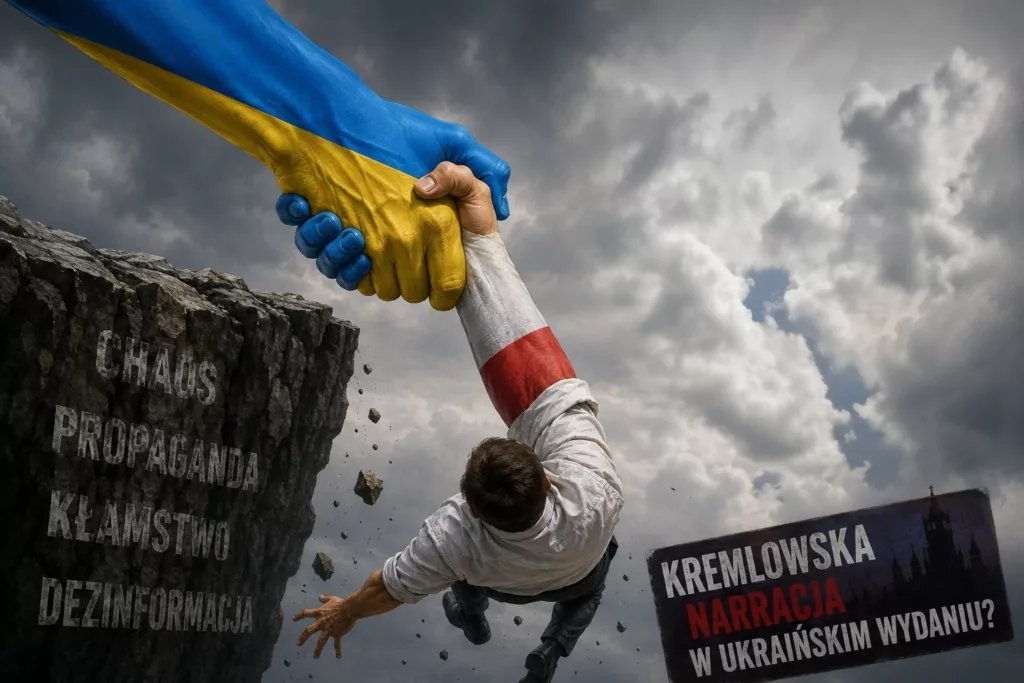
Just a few years ago, it would have seemed unthinkable that some strands of Ukrainian propaganda would begin using exactly the same patterns the Kremlin has relied on for years. Today, it increasingly appears that only the messenger has changed, while the methods remain the same. Conspiracy theories, fearmongering, shifting responsibility onto vaguely defined “major geopolitical players,” attacking the United States, and attempting to influence Polish public opinion by glorifying Ukraine’s leadership in Central and Eastern Europe. The intended outcome is the same – chaos and a weaker Poland.
It is impossible to determine whether all such messages are inspired by the Ukrainian state, Russian intelligence services, or emerge organically. What is undeniable, however, is that social media is increasingly filled with posts repeating narratives that benefit those seeking to destabilize the region. In information warfare, the identity of the messenger is often less important than the impact of the message itself.
Calling the Troll Out
A few hours ago, we published on our Facebook page a statement by Piotr Barełkowski – a Polish journalist, film and television producer, director, media executive, and entrepreneur. Barełkowski, 55, has co-founded or established several news and current affairs media outlets.
In his statement, he points to what he considers to be troubling narratives promoted by media outlets with German capital operating both in Poland and abroad. He argues that Germany is attempting to create an atmosphere of fear in both Western Europe and Poland over an allegedly inevitable Russian attack on Poland.
Uwaga! Mamy kolejną próbę wciągnięcia Polski do wojny z Rosją przez Ukrainę i Niemcy! pic.twitter.com/oRCXdXPh9L
— Piotr Barełkowski (@pbarelkowski) July 4, 2026
According to Barełkowski – a view he says is shared by many experts – Russia currently has neither the objective nor the capability to escalate military operations against Poland, a NATO member state. In his assessment, the media campaign primarily serves to generate fear and social tension, making it easier to align Poland with Germany’s political agenda.
A Comment Beneath the Post
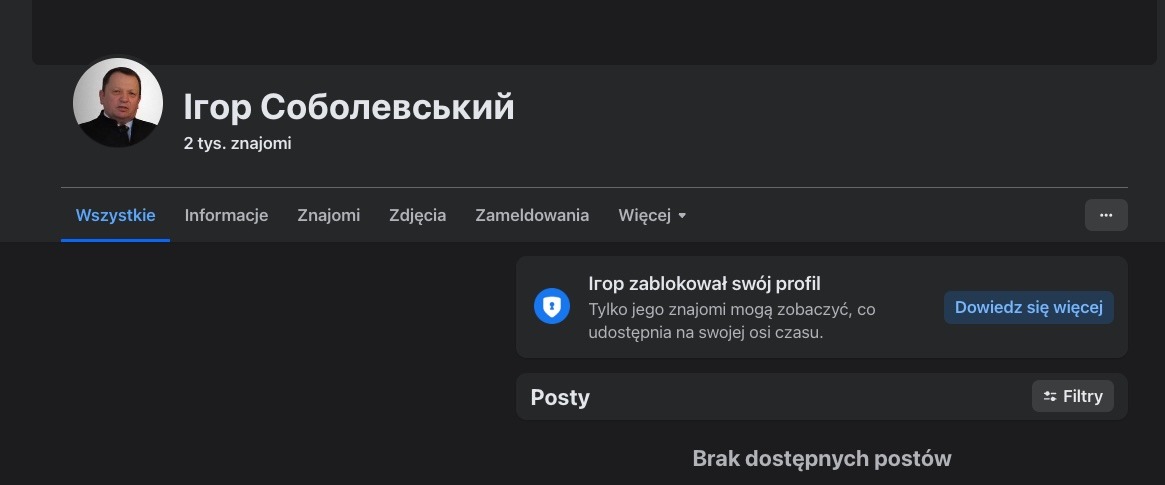
Shortly after Barełkowski’s statement appeared on the PROSTY Z PRAWEJ Facebook page, a comment was posted under the name Ігор Соболевський (Ihor Sobolevskyi). The profile, written in Cyrillic, is locked, making its owner impossible to verify. It is unknown who the person is, where they come from, or whether they are even using their real name.

The comment itself presents an elaborate geopolitical theory. The author argues that the deterioration of Polish-Ukrainian relations was orchestrated by unspecified “major geopolitical players,” claims that Russia is preparing to attack Poland, alleges that the United States wants to prolong the war for the benefit of its arms industry, and suggests that any future Russian aggression against Poland would result from supposed agreements between Vladimir Putin and Donald Trump. Most notably, the propaganda narrative concludes that Ukraine would be Poland’s only possible savior in the event of a Russian attack.
This is a classic propaganda construction. By combining facts, half-truths, and entirely unsupported hypotheses, it creates the illusion of objective analysis while leading readers toward predetermined conclusions.
What Did the Disinformation Poster Write?
Below is the full comment posted by “Ігор Соболевський” for educational purposes, followed by our analysis:
The catastrophic collapse of relations between Ukraine and Poland came as a surprise not only to the international community but also to the overwhelming majority of Ukrainians and Poles.
It is obvious that the average Pole, just like the average Ukrainian, is not responsible for this latest geopolitical shift – it is the work of major geopolitical players carried out through useful idiots.
So who benefits from hostility between these neighboring nations?
There are two beneficiaries.
The first is Russia, which plans to attack Poland but fears Ukraine’s participation because, under current circumstances, nobody except Ukrainians would be able to provide Poland with rapid, effective, and meaningful assistance.
The second beneficiary is the United States, which, on the eve of military operations on Polish territory, does not want to lose Poland’s multi-billion-dollar arms market to modern Ukrainian military technologies. Americans also understand that the participation of the Ukrainian Armed Forces on Poland’s side would shorten the conflict significantly, thereby reducing profits for the U.S. defense industry.
I would not be surprised if it eventually turns out that Russia’s future military aggression against Poland, just like its current aggression against Ukraine, is the result of agreements between Putin and Trump.
Today Ukrainians are paying in blood for this game played by two old men trapped in stagnation; tomorrow, it will be the Poles.
Propaganda – An Analysis
The greatest weakness of this narrative is its complete omission of the events that genuinely led to the sharp deterioration of relations between Warsaw and Kyiv.
Beginning in May and June 2026, the immediate trigger for escalating tensions was President Volodymyr Zelenskyy’s decision to grant an elite Ukrainian special forces unit the honorary title “Heroes of the UPA.” It was this decree that prompted a strong response from the Polish authorities and significantly worsened public sentiment.
Sobolevskyi’s comment completely ignores this fact. Instead of pointing to a concrete political decision, it portrays the conflict as the product of mysterious actions by anonymous forces controlling world affairs. This is a characteristic propaganda technique: remove inconvenient facts and replace them with conspiracy theories.
The United States as the Main Villain
Equally implausible is the claim that the United States would somehow welcome a Russian attack on Poland in order to sustain arms sales. Such reasoning collapses under even the most basic scrutiny.
A Russian attack on a NATO member would risk a war on an incomparably larger scale, enormous economic and military costs, and a threat to the entire Western security architecture. The suggestion that Washington would deliberately pursue such a scenario for commercial reasons is unsupported by any credible evidence. It fails even the simplest test of logic.
Also absent from this narrative is any discussion of Germany’s position – the European Union’s largest economy and a country that, no less than Russia, has strategic reasons to reduce the influence of the United States in Europe.
On the one hand, Germany has suffered economically because of the war in Ukraine, particularly through the loss of unrestricted trade with Russia and access to inexpensive Russian hydrocarbons. On the other hand, it is difficult to ignore Germany’s efforts to use the instability created by the war and the fear generated by Russian aggression to strengthen European integration under its leadership and advance further federalization within the European Union. These developments have been visible in recent years and are supported by substantial evidence.
Kremlin Templates in a Ukrainian Version?
The comment also contains linguistic elements long associated with Russian propaganda. It employs expressions such as “useful idiots,” a phrase deeply rooted in Soviet political rhetoric, along with other dismissive language characteristic of Russian propaganda.
The entire structure follows a familiar pattern. Anonymous “major geopolitical players” are blamed for every problem. The United States is portrayed as the chief manipulator. Russia’s responsibility is blurred, while Poland and Ukraine are simultaneously presented as victims of the same global conspiracy. This is precisely the narrative model that Russian disinformation networks have promoted for years.
What stands out most in this particular propaganda product, however, is that Ukraine is portrayed as Poland’s ultimate rescuer. Previous Kremlin narratives often attempted to present Russia not as the aggressor but as a force guaranteeing peace, stability, and the preservation of conservative values.
This raises two possibilities. Either we are witnessing yet another sophisticated layer of Russian information warfare, or Kyiv has adopted Kremlin propaganda templates and is now attempting to adapt them for its own strategic purposes within the region.
Barełkowski Has Long Warned About Information Warfare
For years, Piotr Barełkowski has warned about propaganda and the influence of foreign-owned media on Poland’s public debate.
In July 2024, he wrote that he had been under sustained attack because of his documentary Krzywda (“Wrong”), devoted to German wartime crimes and their historical consequences. According to Barełkowski, accusations that the film was supposedly “anti-German” were intended to discredit both the production itself and the European historians who participated in it.
Regardless of how one evaluates his views, it is increasingly difficult to deny that information warfare has become just as important a battlefield as economics or military security.
Perhaps the most troubling development is that identifying the source of propaganda has become increasingly difficult. In the past, audiences generally knew when a message originated from Moscow. Today, similar narratives can be spread by anonymous accounts, private individuals, activists, or organizations operating under various banners.
Ultimately, it makes little difference whether the inspiration comes from Moscow, Kyiv, or elsewhere. If the message contributes to greater distrust, deeper social divisions, and a weakening of Poland’s position, the effect is essentially the same.
That is why every attempt to present conspiracy theories as serious geopolitical analysis deserves careful and critical scrutiny – especially when it relies on propaganda techniques that have been perfected by the Kremlin for decades, regardless of who happens to be repeating them today.