


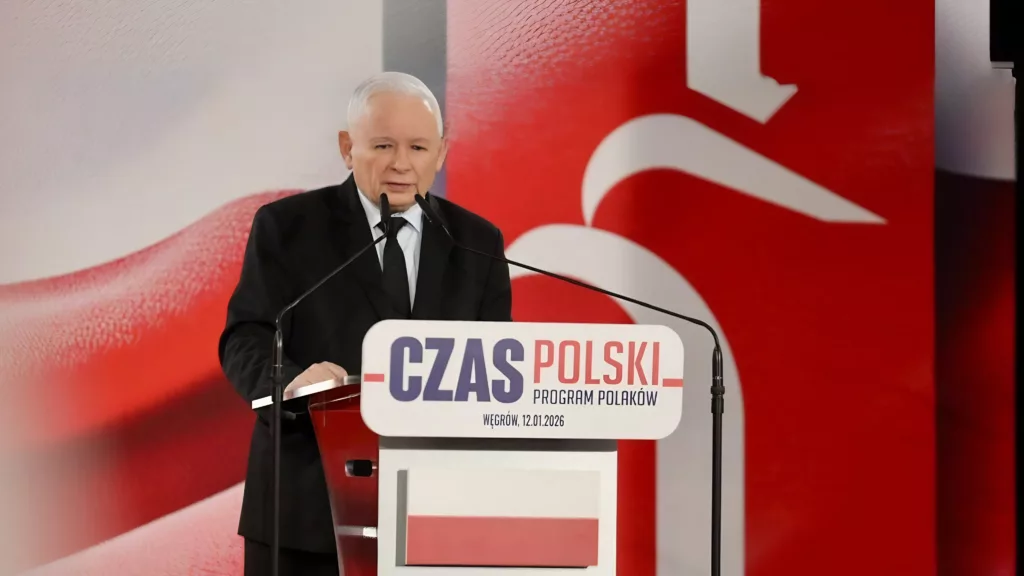
A publication by FAZ about Poland and Donald Tusk’s government sparked a sharp reaction from Jarosław Kaczyński, who argued that German elites treat the concept of “rule of law” as a political tool for subordinating Poland.
Jarosław Kaczyński strongly responded to a publication by “Frankfurter Allgemeine Zeitung” concerning the political situation in Poland after the 2023 change of government. The PiS leader interpreted the German newspaper’s article as confirmation that the concept of “rule of law” is being used politically against countries opposing Berlin’s dominance.
“Frankfurter Allgemeine Zeitung laid its cards on the table: rule of law is in fact pro-Germanism,” Kaczyński wrote on the X platform.
„Frankfurter Allgemeine Zeitung” wyłożył kawę na ławę: praworządność to w istocie proniemieckość.
Zdaniem Niemców przywracanie praworządności, tak jak oni ją rozumieją, Tuskowi nie wyszło… Zgodnie z ich oczekiwaniami partie odrzucające niemiecką dominację miały w Polsce zostać…— Jarosław Kaczyński (@OficjalnyJK) May 20, 2026
He added that, according to the Germans, Donald Tusk had failed to restore the rule of law in the way expected by German political and media elites.
What did FAZ write?
Stefan Locke’s article in FAZ was a review of a book by Martin Adam devoted to political changes in Poland. The German journalist argued that despite Donald Tusk’s camp taking power after the 2023 elections, restoring the “rule of law” has proved extremely difficult.
According to the author, PiS transformed the Polish state during its years in office, especially the judiciary, in such a durable way that even after losing power it has retained significant influence. The article referred to judges loyal to the previous government, clientelist mechanisms and the blocking of political accountability efforts.
FAZ also noted that Tusk’s government faced a dilemma: either accelerate political reckoning and itself violate legal standards, or proceed more slowly while respecting legal procedures. According to the author, the current government chose the “slow and bumpy” path of legally restoring institutional order.
The German newspaper further emphasized that PiS still maintains strong public support. Locke argued this is because the party offers voters a vision of a strong and sovereign nation-state resistant to foreign influence, including German influence. The article cited PiS narratives about Poland “dissolving into the EU” and dancing to Germany’s tune. The author described this narrative as politically effective, though also “absurd”, noting that it draws on Poland’s historical experiences.
Kaczyński: Germany revealed its true expectations
These passages became the basis for Jarosław Kaczyński’s sharp response. The PiS leader argued that the FAZ publication exposed the real expectations of German elites toward Poland. In his interpretation, “rule of law” in practice means weakening or marginalizing political forces opposed to German dominance in Europe.
Kaczyński particularly pointed to the tone of disappointment visible in the FAZ article. According to the PiS chairman, the German newspaper did not hide its frustration that despite the change of government, conservative parties still enjoy strong public support and remain a major political force.
“In line with their expectations, parties rejecting German domination in Poland were supposed to be eliminated, yet they still exist,” Kaczyński wrote.
A dispute over “rule of law” or political sovereignty?
The FAZ publication and Kaczyński’s reaction show that the dispute over the rule of law has long extended beyond questions of the judiciary or constitutional interpretation. Increasingly, it has become a conflict over the political sovereignty of nation-states and the influence of the EU’s largest countries on the domestic politics of others.
Conservative circles have argued for years that the concept of “rule of law” is often applied selectively and politically. In their view, countries resisting the dominant model of European integration are portrayed as problems requiring “correction”. In this context, Kaczyński’s reaction was an attempt to show that German media themselves are becoming less willing to conceal the political dimension of the dispute.