


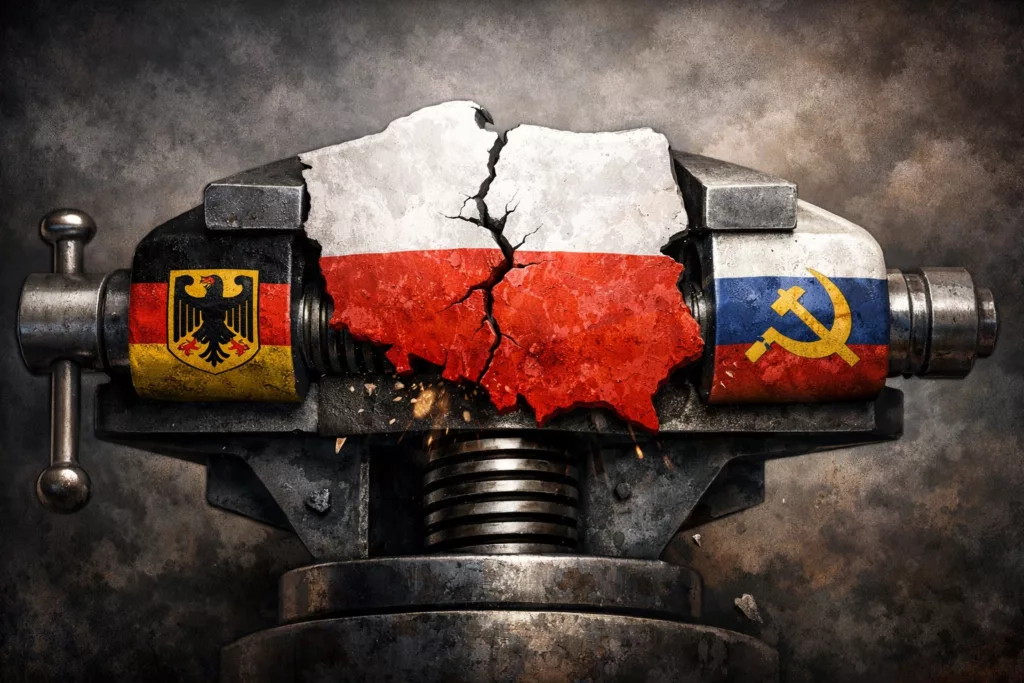
For centuries, relations between Germany and Russia have oscillated between rivalry and surprising cooperation. In many historical interpretations, the existence—or absence—of an independent Poland played a decisive role in shaping this uneasy partnership.
A Strategic Triangle in Europe
The history of relations between Germany and Russia has often been described as a cycle of estrangement and rapprochement. One of the most influential observations on this relationship was formulated by historian John Wheeler-Bennett, who noted that after 1740 the dynamics between the two powers frequently depended on the political status of Poland.
According to Wheeler-Bennett, when Germany and Russia were separated by an independent Polish state acting as a buffer, relations between the two empires tended to remain relatively stable. When their borders met directly, tensions increased and hostility often followed.
This observation reflects a broader strategic logic that shaped European geopolitics for centuries. The territory between Berlin and Moscow was rarely perceived merely as a collection of states. Instead, it often functioned as a geopolitical buffer zone whose stability—or weakness—had implications for the security calculations of both powers.
Within this framework, Poland was frequently treated not as a political subject but as a strategic space influencing the balance between Germany and Russia.
Prussian Pragmatism and the Russian Connection
In the eighteenth century, Prussian rulers openly articulated a pragmatic approach to alliances. Frederick II of Prussia, known as Frederick the Great, emphasized that alliances should serve the interests of the state rather than moral considerations.
Around the end of the Seven Years’ War in 1762, Frederick reportedly advised that rulers should never hesitate to form alliances—but should also be ready to abandon them whenever it becomes advantageous. This approach reflected the broader tradition of raison d’état, where survival and strategic advantage outweighed sentiment or ideological affinity.
Relations with Russia became one of the tools through which Prussia pursued this pragmatic policy. Cooperation with the Russian Empire often served as a means of strengthening Prussia’s position within Europe and balancing other powers.
Periods of tension between Berlin and Moscow certainly occurred, but they were frequently followed by renewed attempts at cooperation whenever strategic interests aligned.
Bismarck and the Logic of Realpolitik
In the nineteenth century, after the unification of Germany under Prussian leadership, Chancellor Otto von Bismarck elevated cooperation with Russia to a central element of German foreign policy.
Bismarck famously summarized the essence of his diplomatic strategy in a short remark: the secret of politics, he suggested, was to maintain a good treaty with Russia.
This thinking culminated in the Reinsurance Treaty of 1887, a secret agreement between Germany and Russia. The treaty guaranteed mutual neutrality in the event of certain conflicts—particularly if France attacked Germany or Austria-Hungary attacked Russia. It also tacitly acknowledged Russian ambitions in the Balkans.
Bismarck’s worldview was rooted in the belief that Germany’s strategic interests were primarily located within Europe rather than overseas colonial expansion. In an often-quoted conversation in 1888, he explained this idea metaphorically by pointing to a map of Europe and remarking that his “map of Africa” lay there—between Russia and France, with Germany positioned in the middle.
For Bismarck, managing relations with these two powers was the central task of German diplomacy.
The “Polish Question” in German Strategy
Within Prussian and later German strategic thinking, Poland was frequently perceived through the lens of geopolitical calculation.
An independent Polish state could serve as a buffer separating Germany and Russia, but it could also complicate cooperation between the two powers. At various times Poland was therefore viewed as a stabilizing barrier, a potential threat, or an object of expansion.
Anti-Polish sentiment was widespread among segments of the Prussian elite in the eighteenth and nineteenth centuries. Historical sources contain numerous hostile remarks about Poles from political figures of the era, reflecting both cultural prejudice and political rivalry.
During the nineteenth century, especially in territories such as Greater Poland and Silesia that were incorporated into Prussia, the Polish population was often seen by authorities as a possible source of internal instability. Policies of germanization, settlement programs, expulsions, and restrictions on the Polish language in schools were introduced as part of efforts to strengthen state control.
In the logic of Realpolitik, suppressing Polish national aspirations was considered necessary to maintain the cohesion and security of the Prussian-led German state.
At the same time, the “Polish question” remained a recurring concern in European diplomacy. The possibility that Polish nationalism might align with rival powers such as France or Russia was sometimes viewed as a potential trigger for wider geopolitical tensions.
History and Its Long Shadows
The complex historical relationship between Germany, Russia, and Poland did not end in the nineteenth century. In the twentieth century it took far more dramatic and tragic forms, culminating in the devastation of World War II and immense human losses across Central and Eastern Europe.
Yet the strategic patterns identified by historians continue to attract attention. The geographical reality of Central Europe—the space between Germany and Russia—remains a central factor in discussions about European security and political stability.
For centuries, Poland’s position within this triangle has shaped not only its own history but also the broader balance of power on the continent.
Whether these historical dynamics belong entirely to the past—or still echo in contemporary politics—remains a question that continues to provoke debate among historians and analysts alike.